
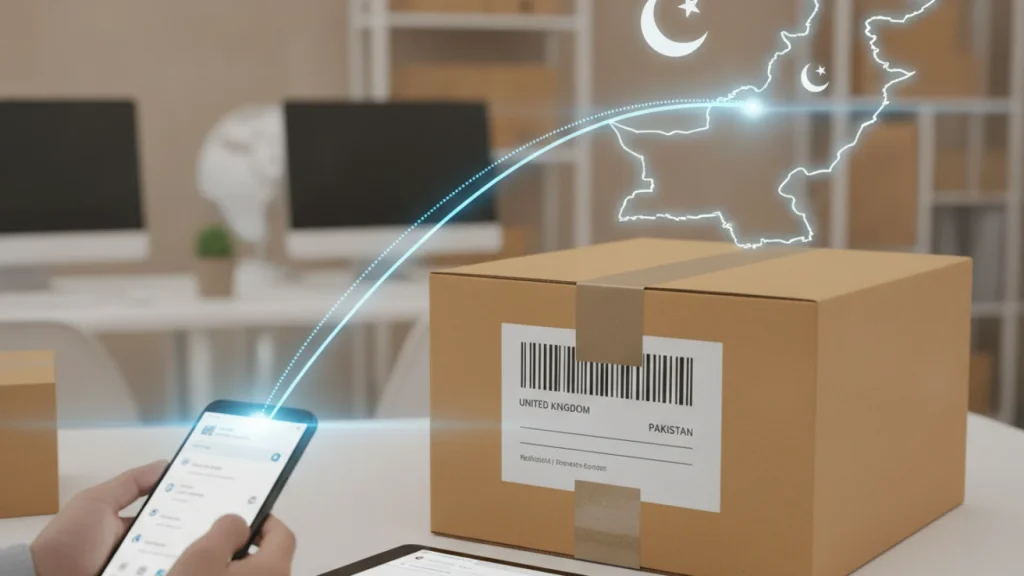
How Real-Time Parcel Tracking UK to Pakistan Works Across International Couriers
Sending a box of personal goods to family in Lahore or shipping commercial stock to Karachi usually triggers the same nervous habit: refreshing the courier page three times a day. When you use parcel tracking UK to Pakistan, you are not watching a tiny live dot move across a map. Instead, you are following a chain of physical scans, paperwork handoffs, and border clearances that shift depending on who is actually moving the freight.
Parcel Tracking Main Points:
The biggest point of confusion comes down to how your parcel is routed:
| Tracking Feature | Standard Postal (Royal Mail to PakPost) | Commercial Express & Freight (DHL, FedEx, Specialists) |
|---|---|---|
| Tracking Identity | Domestic barcode, then UPU standard S10 code | Single Master Air Waybill (AWB) |
| Data Handoff | Disjointed EDI exchange between national posts | End-to-end proprietary internal network |
| Update Frequency | Sporadic (often blind once it leaves Heathrow) | Near real-time at every hub sort |
Every scan marks a milestone event. Your box gets inducted at a local UK depot, bagged into a unit load device (ULD), and sorted at an air hub like Heathrow or East Midlands. At this stage, express carriers assign an Air Waybill. Unlike a standard domestic sticker that just helps a local van driver find your street, an AWB is a legally binding contract that travels with the aircraft manifest. Pakistan Customs officials in Islamabad or Karachi use this exact data to review the contents before the plane even touches down.
Don’t panic if your tracking stalls for two or three days. When cargo is mid-flight across international air corridors—or waiting on a tarmac transfer in hubs like Dubai or Doha—nobody is scanning individual parcels. The same “black hole” happens while a shipment sits in a bonded warehouse awaiting customs assessment. Silence on your screen usually just means your box is waiting its turn in the inspection queue, not that it went missing over the Arabian Sea.
How to Track Your Cargo Online from the UK to Pakistan Step-by-Step
Tracking a box moving halfway across the world rarely happens on just one screen. Once your goods leave a depot in Birmingham or Heathrow, they often swap networks before arriving in Karachi or Lahore. Staying on top of that journey takes a little deliberate effort.

Steps for Tracking Your Cargo Online:
Here is the exact workflow you should follow to keep tabs on your shipment:
- Spot your tracking format immediately. Don’t just paste any reference number from your receipt into a tracker. Commercial freight forwarders and national posts use completely different formats, and mixing them up will return an “invalid number” error.
| Carrier Network | Typical Format Example | Best Place to Track First |
|---|---|---|
| Express Couriers (DHL, FedEx) | 10 numeric digits | Carrier’s proprietary portal |
| Postal Services (Royal Mail / PakPost) | 13 characters (RN123456789GB) |
Royal Mail site until export |
| Freight Consolidators | Varies (often internal airway bill) | Consolidator’s direct web portal |
- Switch to universal aggregators at the border. Royal Mail tracking usually freezes or shows a vague “departed Heathrow” status for days. Once the cargo lands in Pakistan, domestic operations hand off to Pakistan Post, TCS, or Leopards Courier. Plug your reference code into multi-carrier hubs like 17Track or Parcel2Go. These platforms query both the UK source and the Pakistani destination databases simultaneously, revealing the exact domestic line-haul update.
- Turn on email and SMS alerts. Real-time pings protect you from silent clearance failures. If Customs demands duty payment at Jinnah International Airport, a delivery status can stall under an ambiguous label like “Exception.” A text alert lets you contact the local clearing agent before demurrage fees pile up.
- Screenshot milestone timestamps. Every time a package hits major hubs—export scan, customs entry, customs clearance, and local depot arrival—grab a screenshot. If a box goes missing between transit hubs, carriers inevitably point fingers at one another. Having date-stamped records gives you the proof needed to file an insurance claim or initiate a formal carrier investigation without delay.
Key Tracking Statuses and What They Mean at Pakistan Customs Points
When monitoring your parcel tracking UK to Pakistan, the handoff from an international flight to a local bonded warehouse is where updates often freeze. Your parcel has landed at an air cargo terminal—usually Karachi’s Jinnah International, Lahore’s Allama Iqbal, or Islamabad International—and entered the jurisdiction of the Federal Board of Revenue (FBR).
The FBR assesses incoming air waybills to categorize freight for duty or security screening. Seeing a pause here is normal; understanding the specific wording tells you whether to wait or jump into action.
| Tracking Status | Real-World Meaning | Primary Handling Location |
|---|---|---|
| Arrived at Facility | Physical freight is offloaded and awaiting barcode scan by terminal handlers. | Ground handler warehouse (PIA/GSA) |
| Under Inspection | Normal screening via non-intrusive x-ray or random batch review. | Customs Examination Shed |
| Awaiting Duty Payment | FBR has assessed customs tariff; taxes must be settled before gate pass issuance. | Air Freight Unit (AFU) Cash Office |
There is a big operational difference between a routine scan and an administrative hold. An automated security review usually resolves within 24 to 48 hours. A paperwork hold, however, will stall your shipment indefinitely. The most frequent culprit is a missing CNIC (Computerised National Identity Card) number for personal gifts, or an absent commercial invoice detailing itemized values for business goods.
Customs Exception
If your dashboard flashes “Customs Exception” or “Clearance Delay,” do not wait for the courier to call you:
- Check the consignee details: Verify that the recipient’s full name matches their government-issued CNIC or passport exactly.
- Pull the paperwork: Find the original booking invoice, note the HS codes used, and keep proof of value (like an online receipt) ready.
- Contact the destination import desk: Have the local recipient reach out directly to the courier’s Pakistan clearance team rather than UK customer support, quoting the tracking number and the local manifest or Air Waybill (AWB) reference.

Real-World Tracking Scenarios: Air Freight vs. Sea Cargo Timelines
Tracking a box sent from Birmingham to Lahore looks vastly different depending on whether it travels in an airplane belly or a rusty steel shipping box. Managing your expectations saves you from panicking when your status stops updating.
The 3–7 Day Air Express Sprint
Air freight moves fast, meaning your scan events should ping daily. Take a typical journey from London Heathrow (LHR) to Jinnah International in Karachi (KHI):
- Day 1: Picked up and scanned at the UK regional depot.
- Day 2: Export customs cleared; handed over to the airline at LHR.
- Day 3–4: Flight departure, mid-route transit (often Dubai or Doha), and touchdown at KHI.
- Day 5–7: Pakistan customs clearance, transfer to local courier, and out for delivery.
If your air parcel sits on “Manifest Generated” for more than 48 hours before departure, your forwarder likely missed their weekly consolidation cut-off.
The 4–8 Week Sea Voyage and the Port “Black Hole”
Sea cargo requires serious patience. Once a vessel leaves Felixstowe or Southampton bound for Port Qasim, expect dead silence for three to four weeks. Container vessels don’t pull over to scan individual boxes in the Indian Ocean.
The real headache—what freight handlers call the tracking black hole—happens after the ship drops anchor. Your tracker might say “Arrived at Port,” but days turn into weeks with zero updates. This lag happens because containers wait in long queues for customs inspection, gate release, and physical transfer to an off-dock container freight station (CFS) for unpacking.
Your visibility during this phase comes down to how your cargo was packed:
| Cargo Type | Typical Use Case | Tracking Visibility |
|---|---|---|
| FCL (Full Container) | Commercial goods; large relocations | High: Live vessel GPS tracking and direct port gate logs. |
| LCL (Shared Container) | Family gift boxes; small shipments | Low: Tracking freezes completely until the entire box is de-consolidated and individually sorted. |
When using parcel tracking UK to Pakistan for family sea cargo, do not assume your parcel is lost just because the status hasn’t moved in twenty days. De-stuffing shared containers simply takes manual labor, and your individual box won’t see a barcode scanner until it hits the local distribution warehouse floor.

Common Parcel Tracking Mistakes and How to Troubleshoot Lost Updates
When a shipment stalls halfway across the world, panic sets in fast. Yet in most cases, the cargo is moving fine; the visibility is just broken. Mastering parcel tracking UK to Pakistan usually comes down to dodging a few simple data mix-ups.
The most frequent blunder happens right at the keyboard: pasting a retailer’s internal order reference or a booking confirmation into a carrier portal. These internal tags do not ping international sorting hubs. To see movement, you need the master Air Waybill (AWB) or the carrier-issued consignment number—typically an 8-to-12-digit string generated once the freight clears the UK depot.
Another common headache is status confusion. When your UK dashboard suddenly flashes “Delivered,” your family in Lahore or Karachi might still be waiting by the door.
Parcel Tracking:
| Status Displayed | What It Often Actually Means | Next Action |
|---|---|---|
| Delivered | Handed off to a Pakistani domestic partner (e.g., TCS, Leopards). | Check for a secondary local tracking code. |
| Customs Hold | Awaiting paperwork or duties at the airport hub. | Have the receiver call the local agent with the AWB. |
| Undeliverable | Driver could not verify the drop-off location or phone. | Confirm the Pakistani SIM is active for SMS prompts. |
That third row catches people out constantly. Couriers in Pakistan rely heavily on active local mobile numbers. If you entered a UK mobile for the consignee or mistyped a digit, the local driver cannot send the automated SMS for address verification or cash-on-delivery customs clearance.
If your scan log hits a genuine 48-hour standstill during a working week—ignoring standard customs windows—stop refreshing the page. File an official inquiry through your UK forwarder’s portal. Provide the master AWB, a photo of the commercial invoice, and the recipient’s active local phone number. Skipping straight to a merchant chargeback too early just freezes carrier investigations, so let the formal trace run its course first.
Official Customs Regulations and Verified Sources for Cross-Border Clearance
When your tracking dashboard suddenly stalls at “Customs Clearance In Progress,” the holdup usually comes down to documentation mismatches between the UK and Pakistan. Clear-cut tracking depends entirely on clean paperwork submitted well before the plane leaves Heathrow or Manchester.
On the UK side, HM Revenue & Customs (HMRC) requires formal export declarations (submitted via the Customs Handling of Import and Export Freight or Customs Declaration Service systems) for commercial consignments exceeding £900. If you declare a lower export value in the UK to save on paperwork, you create a major headache down the line.
At the destination, the Federal Board of Revenue (FBR) runs declared values through its automated valuation database. Under the Pakistan Customs Tariff (PCT), customs officers do not simply accept the invoice in the pouch. If you send an iPhone or a high-end laptop declared at £150, the FBR system automatically flags the shipment for physical inspection, halting your cargo in Karachi, Lahore, or Islamabad.
Here is how common goods are handled under current PCT rules:
| Category | Valuation & Duty Reality | Common Clearance Trap |
|---|---|---|
| Personal Effects | Handled under the Transfer of Residence rules or standard baggage rates. | Mixing retail-packaged electronics with used clothes triggers commercial audits. |
| High-Value Electronics | Assessed strictly against standard market value databases; mobile phones require PTA approval. | Missing PTA (Device Identification, Registration and Blocking System) clearance blocks release entirely. |
| Commercial Samples | Subject to nominal duties only if visibly mutilated or marked “Not for Sale.” | Sending whole, usable products without proper sample markings attracts full tariff rates. |
To avoid surprises while monitoring your parcel tracking UK to Pakistan, check duties beforehand using the official Pakistan Single Window (PSW) portal (psw.gov.pk). The PSW trade directory lets you cross-reference your specific PCT code, statutory regulatory orders (SROs), and applicable sales taxes before booking the courier.
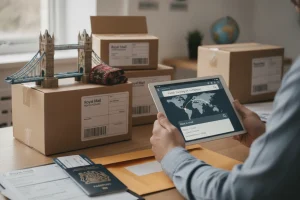
Choosing the Right Courier Service with Reliable Parcel Tracking UK to Pakistan
Not all tracking systems are built the same. If you are shipping electronics to Lahore or personal luggage to Mirpur, the carrier you book determines whether you get genuine real-time visibility or radio silence the moment your box leaves London.
Your choice usually comes down to global express couriers versus community-focused UK-to-Pakistan cargo agents. While specialist door-to-door cargo handlers offer unbeatable rates for heavy boxes, many rely on container consolidation. The tracking updates fine while the pallet sits in a Southall or Bradford depot, but visibility frequently drops off the radar the moment the container boards a ship or plane—only reviving weeks later when a local driver rings the recipient. If missing updates cause you sleepless nights, that trade-off rarely pays off.
| Courier Type | Tracking Strength | Best For |
|---|---|---|
| Express Networks | Real-time scans at every hub via direct API integration | High-value goods, urgent gifts, and legal paperwork |
| Specialist Cargo Handlers | Milestone-based (Depot, Loaded, Port, Out for Delivery) | Large household shipments, excess baggage, non-urgent freight |
Before paying for your collection, verify that your booking software provides these essential safeguards:
Direct customs status alerts:
Pinpoints whether customs in Karachi or Islamabad cleared the parcel or flagged it for duty assessment.
Line-haul milestone pings:
Scans confirm when the crate departs Heathrow or transit hubs in the Gulf.
Digital proof of delivery (e-POD):
Captures an electronic signature and timestamp rather than a vague “delivered” checkmark.
Before you hand over a single parcel, check the claims policy. Many low-cost services cap insurance payouts based on weight—often a trivial sum per kilo—unless you purchase a declared-value rider. Once confirmed, book your collection, enter your reference into the carrier’s portal, and register your WhatsApp or mobile number so clearance alerts reach you immediately. Reliable parcel tracking UK to Pakistan starts with vetting the carrier’s software, not just their postage rates. to track your parcel visit out tracking page ore conteact us on whatsapp.