
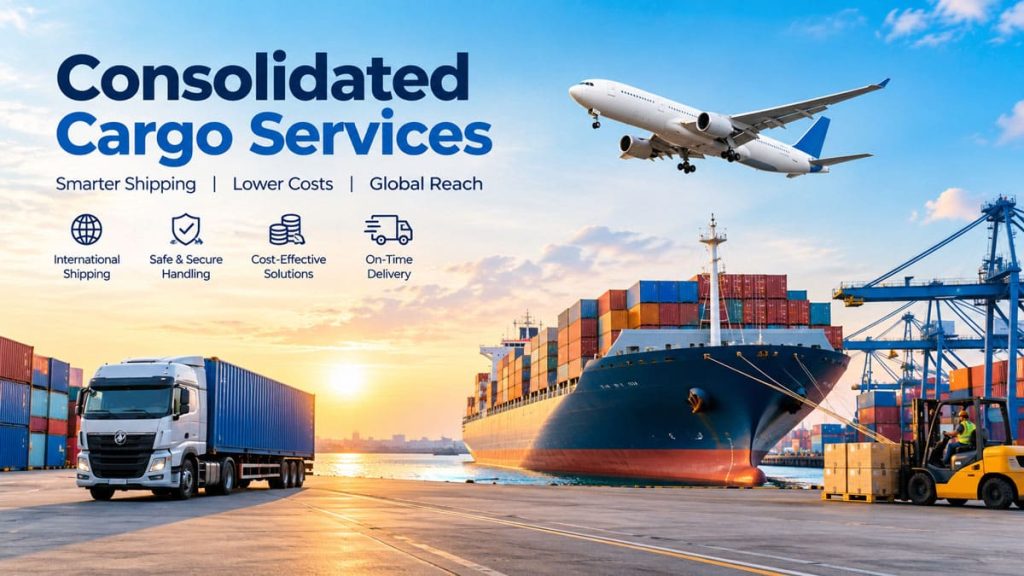
Consolidated Cargo Services Simplify Your International Shipments
Introduction
Shipping goods overseas can feel stressful. Costs add up fast, paperwork piles up, and small shipments often get lost in the process. However, there is a smarter way to move your goods. Consolidated cargo services help you ship more while paying less.
With consolidated cargo services, several shippers share space in one container. Therefore, you pay only for the space your goods use. You do not need to fill an entire container to enjoy international freight rates. This model works well for small businesses, online sellers, and growing importers.
At KCS Couriers, we know that every shipment matters. Moreover, we understand that UK businesses need reliable, clear, and affordable options. In this article, you will learn how consolidated cargo works, who benefits most, and what to check before you book. In addition, you will see how to prepare your goods and avoid common mistakes.
Whether you ship once a month or once a quarter, this guide will help you decide. First, let’s look at what consolidation really means. Then, we will explore the real benefits, the process, and the practical steps you can take today. Clear information makes better decisions, so we keep everything simple. By the end, you will feel confident about your next international shipment.
What Are Consolidated Cargo Services?
Consolidated cargo services combine goods from many shippers into one container. A cargo partner collects your items, groups them with other shipments, and sends them to the same destination. At the end of the journey, the team separates the goods and delivers them to each receiver.
In the shipping industry, people often call this LCL, which means less than container load. However, the idea is simple. You share a container, and you share the cost.
This approach suits shipments that are too big for a parcel but too small for a full container. Therefore, it fills an important gap. Many businesses used to pay high prices for half-empty containers. Now, they can ship smarter.
Moreover, consolidation is not new or risky. Global traders use this method every day. As a result, the process is well tested and reliable.
How Consolidated Cargo Works Step by Step
The process is easier than it sounds. First, you tell your provider what you ship, how much it weighs, and where it needs to go. Next, the provider quotes a price based on volume and weight.
After you accept, the team collects your goods or receives them at a warehouse. Then, staff check, label, and record each item. In addition, they group your cargo with compatible shipments.
Once the container is full, it leaves for the port. Meanwhile, customs paperwork moves forward in the background. When the container arrives, the team unloads it and separates each shipment.
Finally, your goods go to the final address. Throughout the journey, you can ask for updates. Therefore, you always know where your cargo stands.
Good communication matters at every step. Consequently, choose a provider that answers questions quickly.
Key Benefits of Consolidated Cargo Services
The biggest advantage is cost. You pay for the space you use, not the entire container. As a result, shipping becomes affordable even for small loads.
Flexibility is another strong benefit. You can ship small batches more often. Therefore, you avoid waiting until you have enough goods to fill a container. This also helps you keep stock levels healthy.
Furthermore, consolidated cargo services reduce your paperwork stress. Your provider handles much of the planning and coordination. In addition, you deal with one point of contact instead of many.
Safety also improves when professionals handle the process. They pack, label, and track goods with care. Moreover, shared containers often follow fixed schedules, so you can plan ahead.
Finally, consolidation supports greener shipping. When shippers share space, fewer containers travel half empty. Consequently, each shipment leaves a smaller footprint.
Who Should Use Consolidated Shipping?
Many types of businesses gain from this service. Online sellers are a clear example. They often ship moderate volumes and need steady supply chains.
Small manufacturers also benefit. They can send finished goods abroad without booking a full container. Likewise, importers who buy from several suppliers can combine orders into one shipment.
Event organisers, retailers, and wholesalers use consolidation too. For instance, a shop owner may bring in seasonal stock every quarter. Consolidation keeps costs low during that cycle.
Individuals can use it as well. People who move abroad or send large gifts often find it practical. However, they should check the rules for personal goods first.
In short, if your cargo is too large for a courier parcel, consolidation deserves a look.
LCL vs FCL: Which One Fits Your Goods?
Choosing between LCL and FCL affects your budget and your timeline. FCL means full container load. You rent the entire container, and only your goods travel inside.
FCL makes sense when you ship large volumes. Moreover, it gives you more control over loading and unloading. However, the price is higher, and you pay even if the container is not full.
LCL, on the other hand, suits smaller loads. You share space, so you share costs. Nevertheless, shared shipments may take a little longer. The provider must wait for the container to fill and then separate each shipment at the destination.
As a rule of thumb, compare your volume with the container size. If your cargo fills less than half a container, LCL often costs less. Therefore, ask for quotes on both options. A good provider will show you the numbers clearly.
What You Can and Cannot Ship
Most general goods travel well in consolidated containers. Examples include clothing, furniture, machinery parts, electronics, packaged food, and retail stock.
However, some items need special care or approval. Dangerous goods, such as chemicals, batteries, or flammable liquids, follow strict rules. In addition, temperature-controlled goods may need different transport.
Some products are banned or restricted in certain countries. Therefore, always check the import rules at the destination. Customs can hold or reject goods that break the law.
Moreover, tell your provider about anything unusual. For instance, fragile, oversized, or high-value items may need extra protection. Honest details help the team plan better. As a result, you avoid delays and surprise charges.
How to Prepare Your Goods for Consolidation
Good preparation protects your goods and speeds up the process. First, choose strong packaging. Use sturdy boxes, secure tape, and enough padding to stop movement.
Next, use pallets for heavier items. Pallets make loading faster and reduce damage. In addition, wrap the goods tightly so nothing shifts during transit.
Label every package clearly. Include the receiver’s name, address, and contact number. Moreover, add a reference number that matches your paperwork. Clear labels help staff sort shared cargo without mistakes.
Then, weigh and measure each package. Accurate numbers lead to accurate quotes. Otherwise, you may face extra charges later.
Finally, take photos before the goods leave you. Photos show the condition of your items at the start. Therefore, they help if you need to make a claim.
Documents You Need for International Shipments
Paperwork can slow down even the best shipment. Therefore, prepare it early.
Most international shipments need a commercial invoice. This document lists the goods, their value, and the parties involved. In addition, you need a packing list that shows what is inside each package.
Depending on the destination, you may also need a certificate of origin or an export declaration. Some goods require licences or special permits. Moreover, trade rules change over time, so always confirm the latest requirements.
Customs codes also matter. Each product has a code that decides duties and taxes. If the code is wrong, customs may delay your cargo. Consequently, double-check every detail.
A skilled provider can guide you through these steps. However, you remain responsible for the accuracy of your information.
How to Choose the Right Consolidated Cargo Services Provider
Not every provider offers the same level of service. Therefore, compare carefully before you decide.
Start with experience. A provider with a strong track record understands routes, ports, and customs rules. Next, check how clear the pricing is. Hidden fees can turn a cheap quote into an expensive shipment.
Tracking is another key point. You should see where your goods are and when they will arrive. Moreover, look for a team that responds fast and explains things in plain language.
Insurance deserves attention as well. Ask what is covered and what is not. In addition, ask about handling and storage conditions at the warehouse.
Finally, read customer reviews and ask for references. Real feedback shows how a company behaves when problems appear. As a result, you can choose with confidence.
Common Mistakes to Avoid
Several common mistakes can raise costs or cause delays. The first is guessing weight and size. Wrong figures lead to wrong quotes and billing disputes.
Another mistake is weak packaging. Shared containers involve more handling, so fragile packing often fails. Therefore, invest in quality materials.
Many shippers also forget about duties and taxes at the destination. These costs can surprise the receiver. Instead, ask for an estimate in advance.
In addition, some people leave paperwork until the last minute. This habit often causes missed sailings. Similarly, vague product descriptions can trigger customs checks.
Lastly, avoid choosing a provider on price alone. A low quote means little if the service is poor. Consequently, balance cost with reliability.
Smart Ways to Cut Your Shipping Costs
You can lower your shipping costs with a few smart habits. First, plan ahead. Booking early gives you more schedule options and often better rates.
Second, reduce package size. Smaller, tighter packages take up less space. However, never sacrifice protection for size.
Third, combine orders from different suppliers when possible. A single shipment is often cheaper than several small ones. Moreover, it simplifies your paperwork.
Fourth, ask about regular shipping schedules. Repeat shippers may find it easier to plan and budget. In addition, steady routines make your supply chain more predictable.
Finally, review each shipment after delivery. Look at costs, timing, and any problems. Then, adjust your plan for next time.
How KCS Couriers Supports Consolidated Cargo Services
Choosing a reliable partner makes the whole process easier. At KCS Couriers, our goal is to help UK businesses move goods with less stress. We focus on clear communication, careful handling, and practical advice.
When you contact us, we listen to your needs first. Then, we suggest options that fit your cargo, budget, and timeline. Moreover, we explain each step so you know what to expect.
Our approach to consolidated cargo services stays simple. You share the details, and we help plan the route. In addition, we keep you updated along the way.
If you are new to international shipping, do not worry. We guide you through the basics. Therefore, you can focus on running your business while we help with the shipment.
Conclusion
Consolidated cargo services give you a simple way to ship overseas without paying for a full container. You share space, you share costs, and you still get professional handling from start to finish.
Moreover, this method suits many businesses. Online sellers, small manufacturers, importers, and retailers can all benefit. However, success depends on good preparation. Pack well, label clearly, and prepare your documents early.
In addition, choose a provider you can trust. Look for clear pricing, fast communication, and reliable tracking. Therefore, you can avoid surprise costs and unnecessary delays.
If you want to simplify your next international shipment, KCS Couriers is ready to help. Contact our team today, share your cargo details, and take the first step toward smoother, smarter shipping.
FAQs
What are consolidated cargo services?
Consolidated cargo services combine goods from several shippers into one container. Each shipper pays only for the space they use. At the destination, the provider separates the cargo and delivers it to each receiver. As a result, small and medium loads become much more affordable.
Is consolidated shipping slower than full container shipping?
It can be slightly slower. The provider must collect enough cargo to fill the container. Afterwards, the team must unload and sort each shipment at the destination. However, many providers follow fixed schedules, so you can still plan ahead. Therefore, ask your provider for estimated transit times before you book.
How do I know if consolidated cargo is right for my shipment?
First, check the size of your load. If it is too big for a courier parcel but too small for a full container, consolidation is often a good fit. Next, compare quotes for both shared and full container options. In addition, consider your budget and delivery deadline. A good provider will help you choose the best option.
Get a Free Air Cargo Quote → or call us on +44 333 444 7866.