
How Door to Door Cargo from the UK to Pakistan Actually Works
Sending a box of clothes, non-perishable treats, or household appliances back home should feel straightforward. Yet, if you have ever tried booking cheap cargo to Pakistan, you know the terminology can get muddy fast. “Door to door” sounds simple, but your parcel doesn’t travel in a single van from your driveway in Leeds straight to your family’s village in Mirpur.
Here is what really happens behind the scenes:
- UK Collection: A local driver picks up your taped-up cartons or wooden crates in hubs like London, Birmingham, Manchester, or Bradford.
- Depot Consolidation: Your goods head to a regional warehouse where an independent UK consolidator groups dozens of family shipments into shared containers or air pallets.
- Line-haul Transit: International freight forwarders manage the customs clearance and sea-port or airport transit.
- Final-Mile Handover: Once cleared through customs in Karachi or Islamabad, local domestic couriers (such as TCS, Leopards, or the forwarder’s own private fleet) take over for residential drops across Punjab, Sindh, KPK, and Azad Kashmir.
The biggest trade-off you will face right away is transit speed versus your shipping bill:
| Cargo Route | Real-World Delivery Window | Best Suited For |
|---|---|---|
| Air Cargo | 5–10 working days | Urgent gifts, electronics, high-value essentials |
| Sea Cargo | 4–8 weeks | Heavy trunks, bedding, kitchenware, furniture |
Once you confirm your collection slot, reputable services issue a physical receipt or digital barcode. While real-time GPS tracking is rare for budget sea freight while containers sit on the water, you should expect landmark scans: UK warehouse arrival, container departure, Pakistan customs release, and a signed Proof of Delivery (POD) slip once the driver hands the boxes to your family.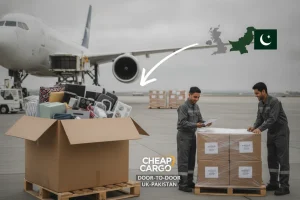
Sea Freight vs Air Freight: Choosing the Most Cost-Effective Route
If your main goal is locking in genuinely cheap cargo to Pakistan, sea freight wins almost every time. But that doesn’t mean it’s the right call for every box you pack. The trick comes down to understanding how cargo handlers charge you.
Sea cargo runs on bulk consolidation. Most forwarders set a minimum booking threshold—usually between 20kg and 30kg (or a flat cubic metre fee). If you pack 10kg into a sea chest, you still pay for the baseline minimum. Once you cross that line, the per-kilo rate drops dramatically, often to a fraction of air rates.
Air freight operates on speed and space. Airlines charge by whichever is larger: physical scale weight or volumetric weight (Length × Width × Height in cm ÷ 5000). Pack a lightweight duvet into a giant cardboard box, and an airline will bill you as if it weighs a ton.

Here is how practical shipments usually split:
Go with ocean freight
Go with ocean freight for heavy, dense, or non-urgent consignments: full household relocations, flat-pack furniture, heavy cookware, winter clothing, and non-perishable pantry goods.
Stick to air transit
Stick to air transit for tight deadlines and high-value smalls: original family documents, wedding wear needed next week, or time-sensitive electronics.
Waiting 6 to 8 weeks for a container ship to dock at Port Qasim makes little sense if your cousin’s wedding is this weekend. Yet, paying air courier rates for 120kg of kitchenware and bedding is a common, expensive mistake. Ocean consolidation absorbs those heavy household kilos for pennies on the pound compared to passenger planes.
Use this quick rule of thumb to pick your lane:
| Shipment Profile | Typical Weight | Best Option | Why It Makes Sense |
|---|---|---|---|
| Handbag, papers, urgent gifts | Under 10kg | Air Freight | Sea minimums make this inefficient; speed matters. |
| Mixed carton of clothes & snacks | 15kg – 25kg | Borderline | Air if needed within 7 days; sea if you can bundle more items. |
| Multi-box house move or heavy gear | 30kg+ | Sea Freight | Maximizes bulk rates; best way to secure cheap cargo to Pakistan. |
Transparent Pricing Breakdown: How to Spot Hidden Fees in Cheap Quotes
A rock-bottom rate per kilo looks great on paper, but low upfront numbers often mask expensive surprises. If you are shopping for cheap cargo to Pakistan, you need to know what a genuine all-inclusive rate actually covers before your boxes leave your doorstep.
A legitimate door-to-door quote breaks down into four basics: the UK doorstep collection, the freight carriage (sea or air), Pakistan customs clearance, and the final-mile van delivery to your recipient’s home.
How to Spot Hidden Fees in Cheap Quotes
Disreputable operators strip these essentials out to make initial quotes look irresistible, only to bill you later.
| Real Door-to-Door Quote Covers | Common “Cheap Quote” Hidden Surcharges |
|---|---|
| UK home pickup | Destination Terminal Handling Charges (THC) |
| Air or sea freight | Unannounced fuel index adjustments |
| Clearance documentation | Remote area fees (outside major cities like Lahore/Karachi) |
| Delivery to recipient’s door | Unexpected destination import VAT or duty cash demands |
The sneaky part is usually the math behind box sizes. Cargo companies charge by whichever is larger: actual scale weight or volumetric weight. For air cargo, standard volumetric weight is calculated as:

If you pack 15 kg of winter blankets into a bulging, flimsy box measuring $60 \times 50 \times 40\text{ cm}$, your volume weight hits 24 kg. You pay for 24 kg. Even worse, if the box bows outward in transit, depot laser scanners measure the widest bulge, instantly bumping up your bill. Use rigid, double-walled boxes and tape them flat to avoid paying for dead air.
Before handing over your parcels or making a bank transfer, pin down your cargo agent with these exact questions:
- Does this price include Karachi port terminal handling (THC) and customs clearance?
- Will my recipient in Pakistan have to pay a single rupee at the door upon drop-off?
- Are there extended-delivery surcharges for smaller towns or rural union councils?
- Are you billing me based on scale weight or volumetric weight?
If an agent dodges giving you a written “all-in” confirmation on WhatsApp or email, walk away. Saving £20 upfront is never worth an angry relative stuck haggling with a courier in Pakistan over ransom fees.
Step-by-Step Guide to Packing Your Goods Safely to Prevent Breakages
Finding cheap cargo to Pakistan feels like a win until a box arrives in Lahore split down the seams. Sea containers endure rough ocean swells, tropical humidity, and multiple depot transfers before reaching your family’s doorstep. If your packing isn’t solid, your savings will vanish on broken goods.
Start with proper materials. Supermarket crisps boxes won’t survive the voyage. You need double-walled corrugated cardboard boxes, heavy-duty cross-weave packing tape (steer clear of standard office tape), edge protectors, and industrial shrink wrap.
How you arrange the contents inside makes or breaks the shipment:
Anchor the base:
Place heavy, rigid items like tinned ghee, lentils, or bulk toiletries flat against the bottom.
Buffer the middle:
Wrap breakables individually in bubble wrap and nestle them right in the center of the carton. Use unstitched fabric, winter jumpers, or bedding around them as natural shock absorbers instead of wasting money on packing peanuts.
Fill the voids:
A box that has air pockets will crush when stacked under five other parcels. Fill every gap to the brim with rolled clothing until the box holds its shape when pressed.
Watch your scales closely. Even if your box has room left, cap the gross weight at 25kg to 30kg. Crossing the 30kg mark usually triggers manual handling surcharges from UK carriers, and overtightened handles easily tear under excessive weight.
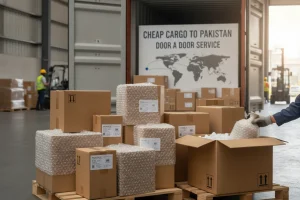
Finally, plan for the Arabian Sea’s humidity and monsoon handling:
| Risk Factor | Packaging Solution | What to Avoid |
|---|---|---|
| Bilge moisture & rain | Line the inner box with heavy-gauge plastic rubble sacks before loading | Thin supermarket carrier bags |
| Pallet crushing | Fit cardboard corner protectors along all vertical edges | Stacking uneven, bulging cartons |
| Exterior dampness | Wrap the sealed carton in 3–4 layers of tight industrial stretch film | Leaving exposed raw cardboard |
Taking an extra twenty minutes per box guarantees your gifts arrive intact, keeping your door-to-door transit affordable from collection to delivery.
Pakistan Customs Rules: Prohibited Items and Duty-Free Allowances
Getting your shipment stuck at Port Qasim or Karachi Airport is every sender’s worst nightmare. The Federal Board of Revenue (FBR) enforces strict baggage rules on non-commercial personal effects, and clearing customs isn’t as simple as declaring everything a “gift.” If an inspector suspects commercial intent, hefty duties kick in immediately.
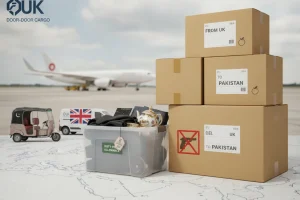
Most legitimate door-to-door operators clear your goods under consolidated groupage schemes (essentially pooling personal luggage under standard Baggage Rules). This makes booking cheap cargo to Pakistan viable, but it only works if everyone plays by the book. One undeclared contraband item can hold up an entire sea container.
What Stays Out
Don’t pack these under any circumstances. You risk outright confiscation, heavy fines, or police reports:
- Banned items: Alcohol, pork products, firearms, ammunition, and narcotics.
- Restricted high-value goods: Cash, unworked precious metals, and commercial volumes of branded cosmetics or designer clothing.
- Phones and tablets: Any smartphone incurs steep Pakistan Telecommunication Authority (PTA) taxes. Sneaking a late-model iPhone into a carton of used clothes usually ends with a seized phone and a hefty penalty.
Paperwork You Need Ready
Before the driver picks up your boxes in the UK, make sure your paperwork is sorted. You need:
- A copy of the sender’s UK ID (passport or driver’s license).
- A clear copy of the recipient’s valid CNIC (Computerised National Identity Card).
- A specific itemized packing list—write “5 cotton shirts, 2 pairs of trainers,” not just “used clothes.”
| Item Category | FBR Customs Treatment | Best Practice |
|---|---|---|
| Used personal clothing & shoes | Duty-free within reasonable family limits | Pack clean, unboxed clothes without retail tags. |
| Small kitchen appliances | Generally permitted; low or no duty | Limit to one of each type per consignment. |
| Mobile phones & laptops | Heavily taxed under PTA / standard tariff | Carry in hand luggage or register via PTA DIRBS directly. |
Double-check your recipient’s CNIC expiry date before booking. A simple mismatch between the receiver’s name on the box and their national ID will freeze clearance at the port.
You can also track your parcel by visiting out tracking page or contact us on whatsapp.