
How Air Freight from the UK to the UAE Works
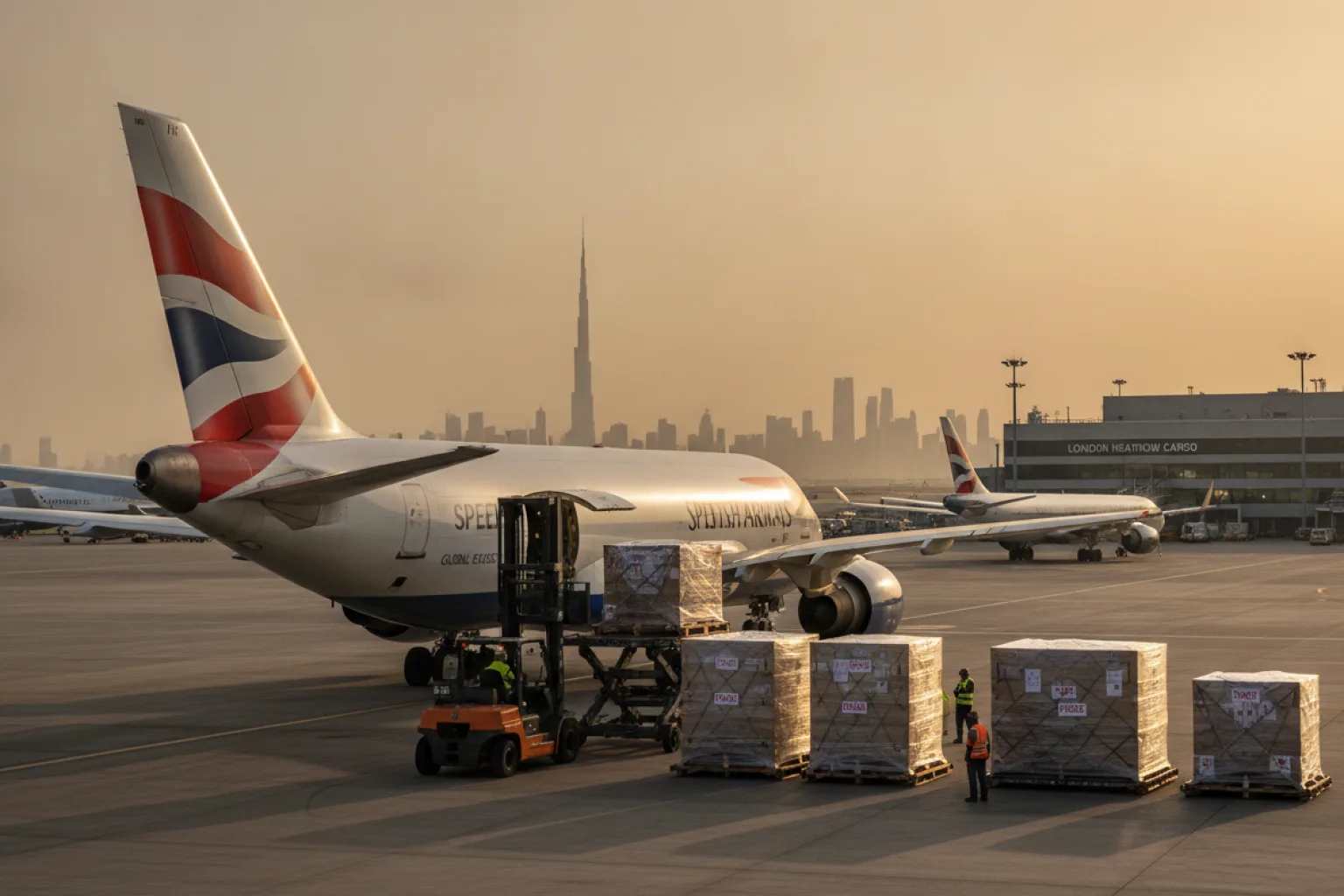
Getting goods to the Emirates quickly often comes down to balancing urgency against your bottom line. If you need to send cargo to UAE by air, the route is well-trodden, linking major UK export hubs like London Heathrow (LHR) and Manchester (MAN) directly with Dubai International (DXB), Dubai World Central (DWC), and Abu Dhabi (AUH). Here is a clear look at how the journey unfolds, what services exist, and how to get your shipment booked into an aircraft hold.
The journey starts at an off-airport consolidation warehouse in the UK, where your boxes or shrink-wrapped pallets are weighed, measured, and X-rayed. Once clear, your freight is tendered to an airline. The speed of that flight depends heavily on whether you pay for guaranteed belly space or settle for standard consolidation.
| Service Tier | Typical Transit | Best For | Typical Routing |
|---|---|---|---|
| Express Priority | 24–48 hours | Line-down factory parts, urgent contracts, perishables | Direct via Emirates SkyCargo or BA World Cargo |
| Standard Freight | 3–5 working days | Commercial restocks, larger B2B shipments, crated machinery | Direct or indirect via European hubs |
Choosing the wrong shipment category is a common, expensive misstep. General air cargo covers bulk freight—think stacked Euro-pallets or heavy cartons moving under a master Air Waybill (AWB). It requires commercial invoicing, packing lists, and local customs clearance on arrival. Conversely, specialized courier consignments suit small parcels, critical legal documents, or high-value personal effects. These ride through integrated parcel networks with automated clearance, saving you paperwork headaches on lighter boxes.
To get started, secure your Air Waybill (AWB) through a freight forwarder. For urgent freight, ask them to secure dedicated hold allocations rather than “standby” space; passenger baggage always takes priority on full flights, and unconfirmed cargo risks getting bumped until the next departure.
Calculating Air Freight Costs: Actual Weight vs. Volumetric Weight
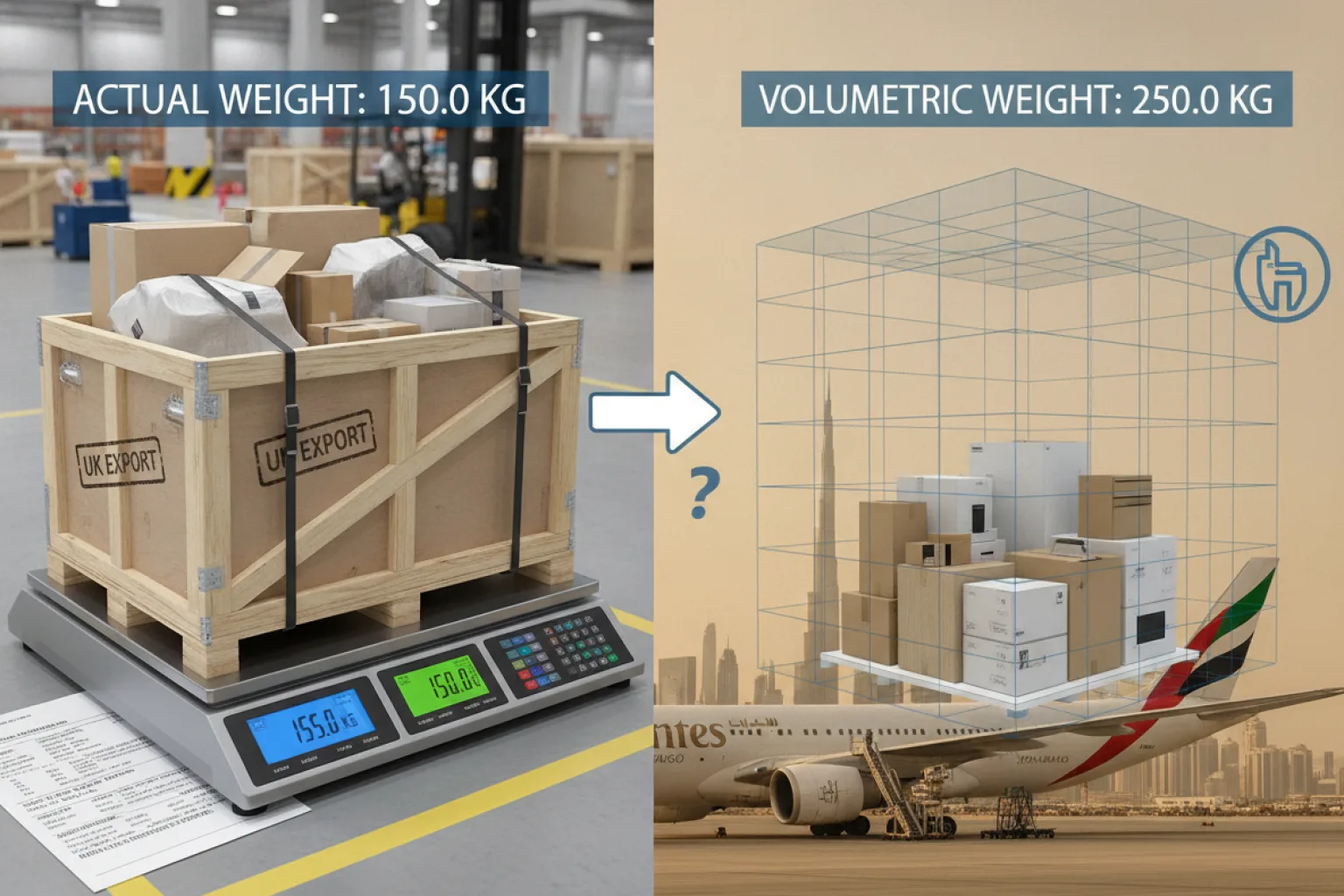
If you place a 15kg steel gear on a scale, it weighs 15kg. If you pack 15kg of cashmere sweaters into a giant carton, it still weighs 15kg on that same scale. But the airline flying your goods out of Heathrow won’t charge you the same rate for both.
A cargo hold runs out of space long before an aircraft hits its physical lift capacity. To balance this out, airlines use the IATA volumetric weight formula:
Length (cm) × Width (cm) × Height (cm) ÷ 6,000
You are charged whichever number is higher: the scale weight or the dimensional weight. This result is your chargeable weight.
| Cargo Type | Dimensions (L × W × H) | Gross Weight | Volumetric Weight | Billable Weight |
|---|---|---|---|---|
| Machinery part | 40 × 30 × 25 cm | 15 kg | 5 kg | 15 kg (Actual) |
| Textile carton | 80 × 60 × 60 cm | 15 kg | 48 kg | 48 kg (Volume) |
That oversized box of textiles costs more than triple to fly because it occupies space that could otherwise carry paying freight.
Beyond base rates, your final quote includes standard line items you should always check before booking:
Fuel Surcharges (FSC)
Tied to global jet fuel indices and updated regularly.
Security Screening Fees (ISS)
Covers X-ray, explosive trace detection, or canine checks at UK depots.
Terminal Handling Charges (THC)
Ground fees charged by origin and destination airport hubs (like DXB or DWC) for moving freight between warehouse docks and the tarmac.
To keep costs down when you send cargo to UAE by air, shrink your profile. For soft goods, vacuum-packing removes dead air and can drop billable volume by half. If you are crating cargo, build the wood around the cargo footprint—don’t pad empty corners with bubble wrap. Just avoid over-compressing fragile goods, as squashed cartons often buckle during transit, risking denied boarding at the gate.
UAE Customs Clearance Rules, Prohibited Items, and Required Documentation
Clearing customs in Dubai or Abu Dhabi isn’t difficult, but it is entirely unforgiving of sloppy paperwork. When you send cargo to UAE by air, local border agents expect zero discrepancies between your physical freight and what is declared on your forms.
On the UK side, your journey begins with HM Revenue & Customs (HMRC). You must hold an active GB EORI number and submit an export declaration via the Customs Declaration Service (CDS, which has replaced the older NES route). Once your flight lands in the Emirates, clearance falls under the Federal Authority for Identity, Citizenship, Customs and Port Security (ICP) and local emirate authorities like Dubai Customs.
Standard commercial cargo usually incurs a 5% customs duty based on the CIF value (Cost, Insurance, and Freight), alongside a 5% local Value Added Tax (VAT).
Mandatory Shipping Documents
To prevent your shipment from being impounded at DWC or DXB, hand your freight forwarder these four records:
Commercial Invoice
Must detail accurate HS codes, currency, terms of sale (Incoterms), and country of origin.
Packing List
Broken down by carton or pallet, showing gross and net weights that match the scale weights precisely.
Certificate of Origin (COO)
Legalized by the Arab-British Chamber of Commerce if required for specific commercial lines.
Air Waybill (AWB)
Your master transport contract issued by the air carrier.
Restricted vs. Prohibited Goods
Do not assume standard consumer items can fly without prior clearance. The UAE enforces strict boundaries between outright bans and goods requiring advance ministerial sign-off:
| Category | UAE Regulatory Status | Action Required |
|---|---|---|
| Narcotics & Betel Leaves | Strictly Prohibited | Absolute ban; zero tolerance |
| Pork & Non-Halal Meat | Controlled / Restricted | Needs specialized municipal permits |
| Cosmetics & Electronics | Regulated | MoIAT conformity certificate needed |
| E-cigarettes & Vape Juice | Heavily Taxed / Controlled | Must pass ESMA standards + 100% excise |
Skipping the Ministry of Industry and Advanced Technology (MoIAT) registration before your flight departs Heathrow or Manchester is the fastest way to rack up daily airport demurrage fees. Get your permits cleared before your goods leave the tarmac.

Common Mistakes Shippers Make When Sending Express Cargo to Dubai and Abu Dhabi
Getting goods onto a direct flight out of Heathrow is the easy part. The real friction happens on the ground in the Emirates, where minor oversights quickly turn into costly logjams. If you plan to send cargo to UAE by air, dodging these four operational traps will save you days of administrative grief.
1. Undervaluing Cargo on the Commercial Invoice
Trimming declared values to save your buyer a few dirhams on import duty backfires almost every time. Dubai Customs and Abu Dhabi Customs cross-reference commercial invoices against automated valuation databases. Discrepancies prompt immediate physical inspections, administrative fines starting in the thousands of dirhams, and potential impoundment at DXB or AUH. Always declare the true transaction value—down to the exact penny and currency code.
2. Leaning on Standard Carrier Liability
Many first-time shippers assume the airline will replace lost or damaged freight. In reality, airline payout caps are tied to the Montreal Convention, which compensates by weight, not value.
| Protection Type | Coverage Basis | What It Actually Pays Out |
|---|---|---|
| Airline Liability (Montreal Convention) | Weight-based (~22 SDRs per kg) | Roughly £20–£22 per kilo, regardless of true value |
| All-Risk Marine/Air Insurance | Declared commercial invoice value | 100% of invoice value plus freight costs |
If an expensive, lightweight server chassis drops from a forklift, carrier liability leaves you out of pocket. Always secure independent, all-risk transit cover.
3. Skimping on Export-Grade Packaging
A standard single-wall box from a UK warehouse will not survive this corridor. Your cargo moves from pressurised, cold aircraft holds straight onto tarmac ramps in Dubai where temperatures routinely hit 45°C. Condensation softens weak cardboard, and the weight of stacked freight crushes corners. Use heavy-duty, double-walled corrugated boxes with internal desiccant packs to handle the brutal humidity shift.
4. Forgetting the Consignee’s Paperwork
Your air waybill means nothing if your receiver cannot legally clear the freight. Before dispatch, confirm:
Business consignees
Hold an active UAE trade license with an import code matching the cargo category.
Private individuals
Provide a verified Emirates ID or active passport with UAE residence visa prior to flight arrival.
Missing documents mean your consignment sits on a bonded warehouse racking system, racking up daily demurrage fees before clearance even begins.

Step-by-Step Checklist: Preparing Your UK-to-UAE Air Shipment for Fast Transit
Express transit times crumble the moment your paperwork hits a snag at customs. When you need to send cargo to UAE by air without delays on the tarmac, preparation at your UK facility makes all the difference.
Here is the exact operational sequence we use to keep freight moving smoothly from Heathrow or Manchester into Dubai:
Reconcile your tariff codes
Don’t assume your 8-digit UK Integrated Tariff commodity code maps perfectly into the Emirates. Cross-reference your goods against the UAE Unified Customs Tariff (GCC Common Customs Tariff). A slight mismatch in classification can hold pallets in customs quarantine at DXB or DWC while officials reassess duties.
Vet your forwarder’s local footprint
Always book through a BIFA-accredited UK forwarder, but dig deeper: ask who handles their breakbulk and ramp transfers in the Emirates. Partners with direct links to Dnata cargo terminals clear ramps hours faster than brokers relying on third-party handoffs.
Upgrade packaging and labelling
Standard shipping labels tear in humid cargo holds. Use weather-resistant thermal tags displaying the master airway bill (MAWB) number, orientation arrows, and the UAE consignee’s direct mobile number—local couriers will not deliver without calling first.
Pre-clear via Dubai Trade
Settle freight charges early so your broker can upload commercial invoices and packing lists to the Dubai Trade Portal while the plane is still over European airspace.
| Preparation Step | Common Mistake | Operational Fix |
|---|---|---|
| Tariff Mapping | Relying solely on UK export HS codes | Match to 8-digit GCC Unified codes before flying |
| Labelling | Missing local phone numbers on crates | Print destination tags with a active UAE mobile (+971) |
| Duty Payment | Waiting for cargo arrival notice | Pre-pay via Dubai Trade Mirsal II for immediate ramp release |
Once the wheels go up, keep eyes on three specific tracking milestones: departure scan, customs clearance processing, and cargo release at the handling sheds. Address exceptions instantly to secure genuine express turnaround.

FAQS
How long does it take to send cargo to UAE by air from the UK?
Direct airport-to-airport transit from Heathrow or Manchester to Dubai (DXB) takes roughly 7 to 8 hours in the air. On paper, that sounds lightning fast. In reality, your total door-to-door timeline usually lands between 2 to 5 working days.
The variance almost always comes down to export customs processing in the UK and local clearance through Dubai Customs. If you choose an express consolidated service, you save money, but your goods wait an extra day or two at the UK depot while the pallet fills up.
| Air Service Type | Typical Transit Time | Best For |
|---|---|---|
| Direct Express | 1–2 working days | Critical machine parts, urgent documents |
| Standard Air Freight | 3–5 working days | Commercial retail, general household boxes |
| Consolidated Air | 5–7 working days | Budget-conscious shipments over 100 kg |
What items are not allowed when you send cargo to UAE by air?
The UAE enforces strict import laws, and aviation security adds another layer of restrictions. A common mistake is packing everyday items that contain hidden hazards.
Avoid packing:
Lithium batteries
(loose power banks are outright rejected; electronics with built-in batteries require strict UN3481 documentation)
Pork products and poppy seeds
(the latter carries zero-tolerance legal penalties in the UAE)
E-cigarettes and vape liquids
(frequently seized unless backed by commercial Ministry of Health approvals)
Aerosols, perfumes, and alcohol
(classified as dangerous goods requiring costly hazardous handling fees)
How much does it cost to send cargo to UAE by air?
Airlines charge by chargeable weight—either actual gross weight or volumetric weight ($L \times W \times H \text{ in cm} \div 6,000$), whichever is higher.
Generally, standard airport-to-airport rates range from £1.80 to £4.50 per kilogram, depending on shipment volume. Shipments under 45 kg carry much higher base rates, making courier services more sensible. Once you cross 100 kg, baseline rates drop significantly, though you must still factor in airline security surcharges, fuel fees, and UAE import VAT (standard 5%).
Conclusion
Choosing to send cargo to UAE by air comes down to balancing speed against your margins. If you are shipping critical spare parts to an energy firm in Abu Dhabi or high-end retail stock to a boutique in Dubai Mall, paying the air freight premium makes total commercial sense. Your goods arrive in days rather than the month-long journey through the Suez Canal.
However, air freight is a poor fit for low-margin, heavy cargo. Shippers often get stung by the volumetric weight rule. Airlines charge by whichever is larger: the actual gross weight or the space the pallet takes up (calculated as length x width x height in centimetres divided by 6,000 for standard air cargo).
Here is how the main UK-to-UAE routing choices stack up when you book your space:
| Service Tier | Typical Transit | Best Used For | Watch Out For |
|---|---|---|---|
| Express Air Courier | 1–2 working days | Urgent documents, high-value samples | High per-kilo minimum rates |
| Direct Air Freight | 2–4 working days | Standard pallets, commercial cargo | Customs clearance delays at DXB/DWC |
| Deferred / Indirect | 5–7 working days | Budget-conscious shipments | Multiple handling points / transhipment risk |
Before you hand your crates over to the driver, double-check your paperwork:
Attestation needs
UAE customs is strict about commercial invoices and certificates of origin. Missing an official stamp can trap your freight in a Dubai bonded warehouse for days, racking up storage fees.
HS code accuracy
Never guess a tariff code. An incorrect digit can lead to immediate rejections, surprise duties, or manual inspections by customs officers.
If time is your priority, air transport delivers unmatched reliability across the Emirates. Just protect yourself on costs: pack your boxes as densely as possible to cut down on dead space, get your paperwork stamped early, and keep your consignee’s trade licence handy.