
Why Choose Air Freight to Send Cargo to India Over Ocean Shipping?
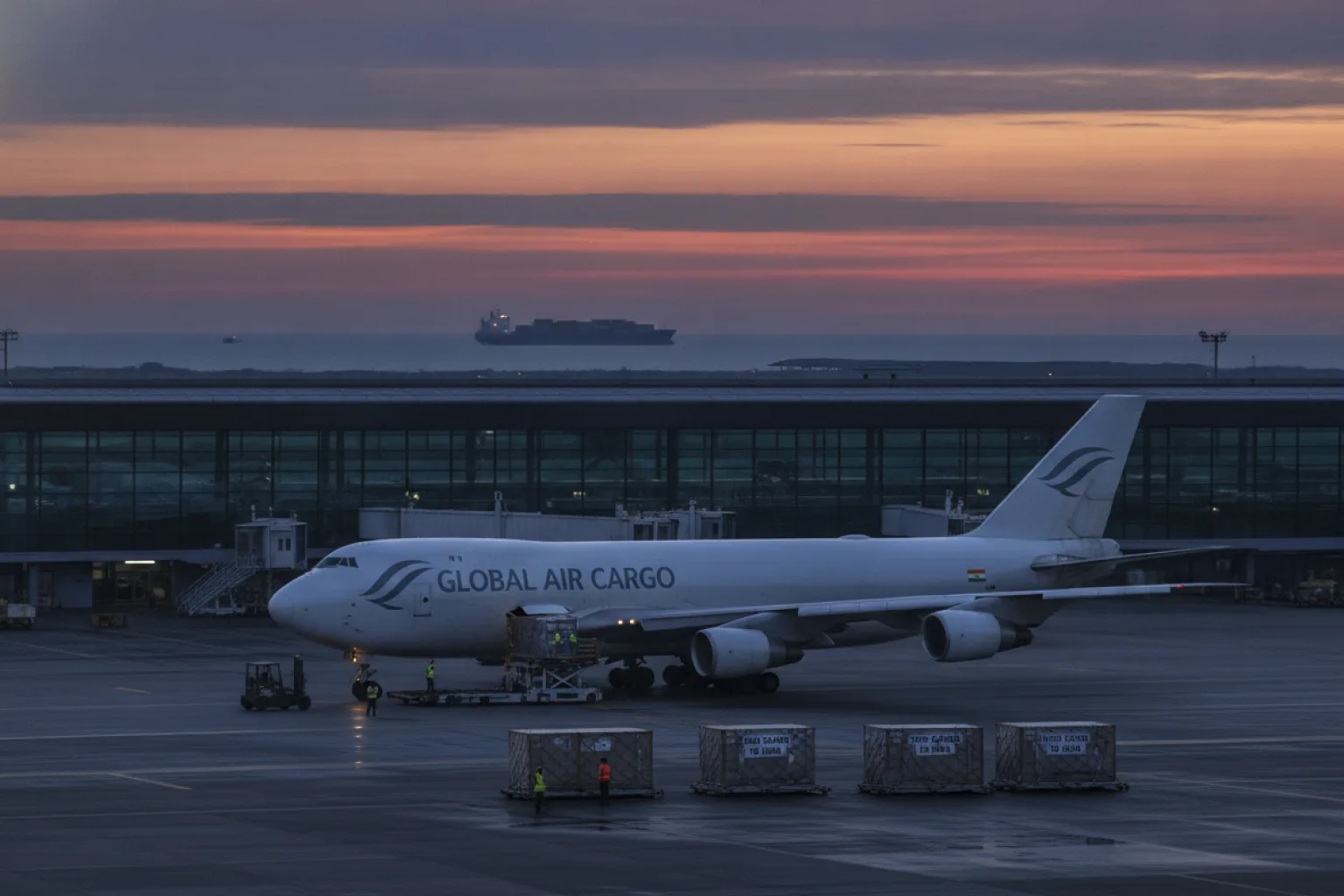
When a customer in Mumbai or Hyderabad is waiting on an order, you quickly face the classic logistics crossroads: the airport tarmac or the ocean dock. While ocean freight handles the heavy lifting of global trade, deciding to send cargo to India by air comes down to balancing urgency, product vulnerability, and hidden inventory costs.
The biggest contrast lies in the calendar:
| Shipping Factor | Air Freight to India | Ocean Freight to India |
|---|---|---|
| Transit Time | 3–7 business days | 30–45 days (Nhava Sheva / Chennai) |
| Cargo Risk | Climate-controlled, strict ramp security | Salt-air corrosion, container sweat |
| Handling Touchpoints | Minimal (mechanized pallet loading) | Multiple (cranes, drayage, yard stacking) |
Ocean transit can tie up capital for six weeks while containers sit through rough monsoons and congested port gates. In contrast, air transit clears customs rapidly at hubs like Delhi (DEL) or Bengaluru (BLR). That speed makes air cargo indispensable for specific profiles:
- Temperature-sensitive pharmaceuticals requiring unbroken cold chains
- Assembly-line replacement parts where every hour of factory downtime bleeds revenue
- High-value electronics and luxury samples vulnerable to pilferage
- Urgent personal relocations where waiting months for basic home goods simply isn’t an option
The upfront airway bill looks steep next to an ocean bill of lading, but looking solely at freight rates misses the bigger financial picture. Because flight legs take days rather than months, your total cost of ownership drops in subtle ways. You tie up far less cash in pipeline inventory, skip costly warehouse staging at port cities, and benefit from lower marine cargo insurance premiums thanks to airport security protocols.
Unless you are moving bulk commodities, heavy industrial raw materials, or non-urgent oversized freight, the speed and security of flying your goods easily justify the investment.
How Indian Customs Clearance Works for Air Cargo: Duty, Taxes, and Documents
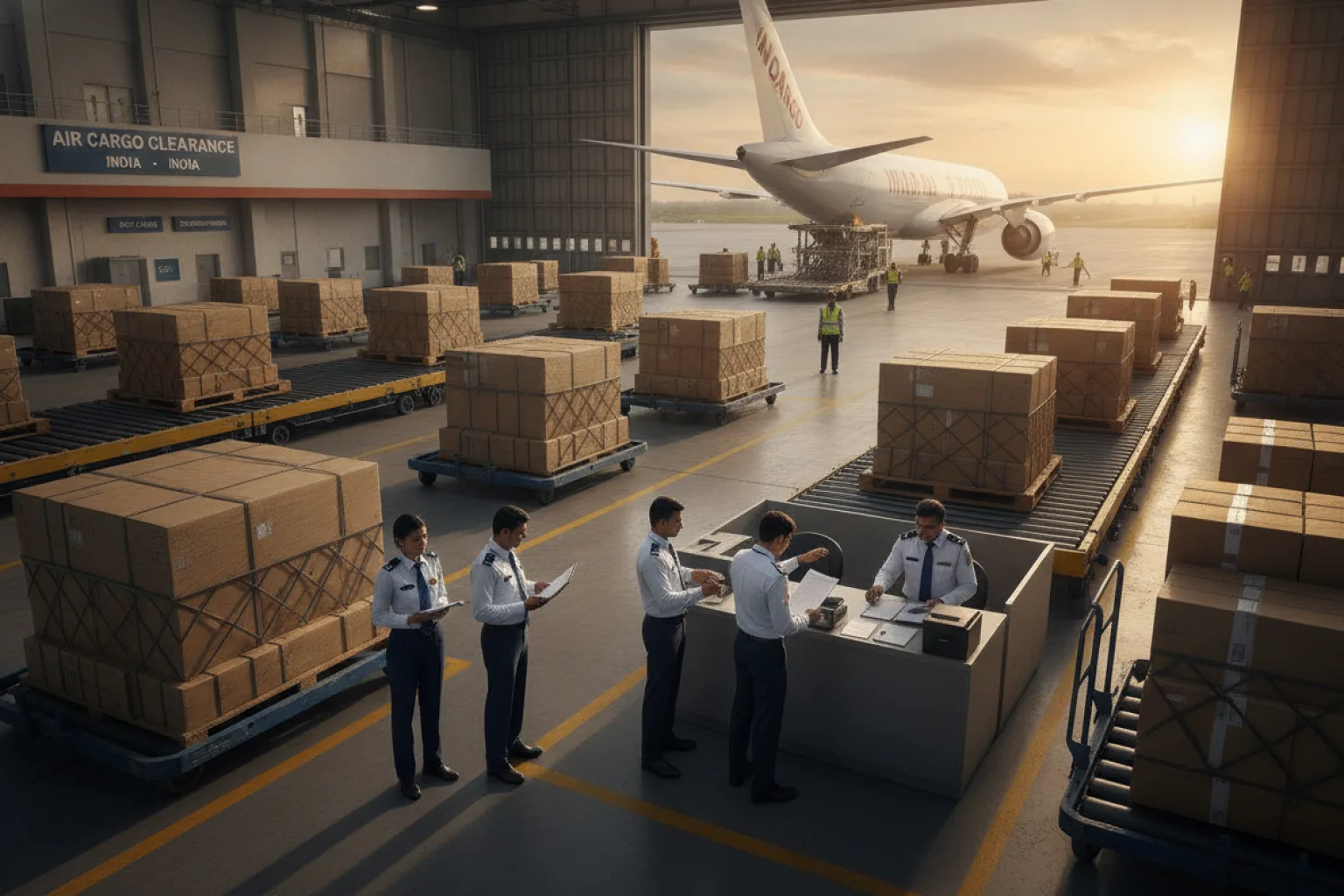
Clearing a flight shipment through Indian customs isn’t as intimidating as it looks, but it is entirely unforgiving of sloppy paperwork. When you send cargo to India by air, your shipment lands under the watchful eye of the Central Board of Indirect Taxes and Customs (CBIC) via the electronic ICEGATE portal. Whether you are touching down at Delhi’s Indira Gandhi International (DEL) or Mumbai’s Chhatrapati Shivaji Maharaj (BOM), the process moves fast—provided your paperwork matches your cargo down to the last decimal.
The Non-Negotiable Document Trail
Your freight forwarder must lodge documents into ICEGATE before the plane wheels touch the tarmac. A single typo between sheets can leave pallets stranded in bonded storage, racking up demurrage fees by the hour.
You need four primary records:
- Airway Bills (MAWB & HAWB): The airline issues the Master bill; your forwarder issues the House bill detailing the actual shipper and recipient.
- Commercial Invoice: Must clearly show unit values, full item descriptions, currency, and country of origin. Vague terms like “samples” or “parts” trigger instant physical inspection.
- Detailed Packing List: Breaking down net weight, gross weight, and package dimensions per box.
- KYC Documentation: India enforces strict Know Your Customer rules before releasing goods.
For individuals receiving shipments, you must supply government-issued ID like an Aadhaar card or Passport matching the delivery address. Commercial consignees must hold an active Import Export Code (IEC) and valid GST registration linked directly to their customs profile.
Decoding the Duty Formula
Customs duties in India are calculated sequentially, not as a flat fee. You pay duty on the Assessable Value (CIF: Cost + Insurance + Freight).
| Tax Component | What It Covers | Standard Baseline |
|---|---|---|
| BCD (Basic Customs Duty) | Base tariff tied directly to the item’s HS Code | 0% to 35%+ |
| SWS (Social Welfare Surcharge) | An extra levy assessed on the BCD amount | 10% of BCD |
| IGST (Integrated GST) | Applied to the combined total (CIF + BCD + SWS) | Typically 18% or 28% |
A common trap for businesses is undervaluing air freight costs on the invoice. CBIC officers compare declarations against international rate averages; if your stated freight looks unrealistically low, valuation teams will reassess the shipment at standard market tariffs, delaying clearance for days. Check prohibited lists beforehand—narcotics, unapproved wireless gear, and certain refurbished electronics will simply be confiscated on arrival.
Step-by-Step Guide: How to Safely Pack and Book Your Air Shipment to India
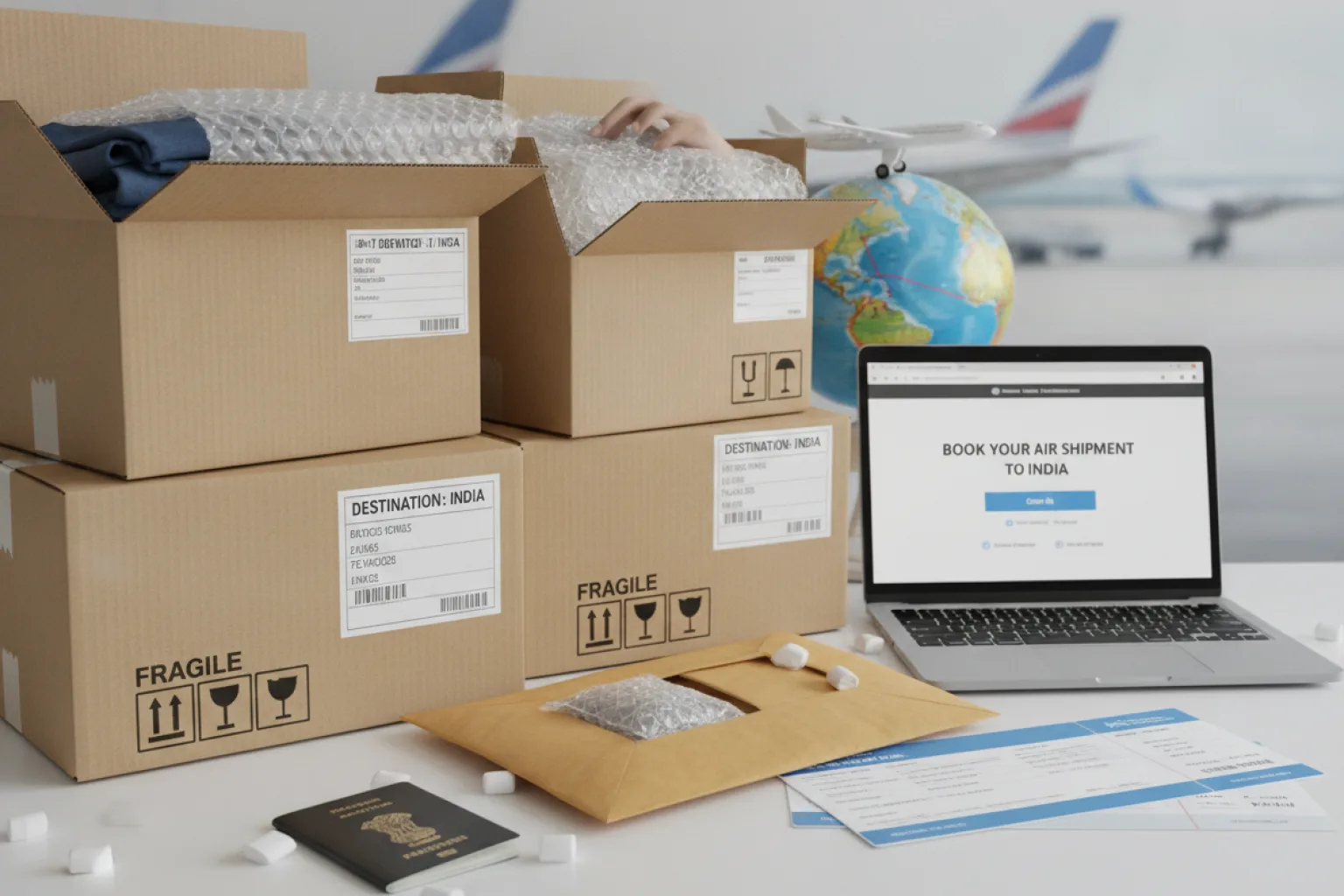
Getting your items flight-ready takes more than taping up an old Amazon box. If you want to safely send cargo to India by air, you need to prep for turbulence, cargo-hold pressure changes, and strict customs scrutiny before you ever hand the parcel over.
1. Calculate Your Chargeable Weight First
Airlines charge based on space or heft—whichever earns them more.
- Gross weight: What the scale says when you set the box down.
- Volumetric (dimensional) weight: Length × Width × Height (in cm) ÷ 5,000 (standard for air express) or 6,000 (typical for economy air freight).
If you pack a light, 4 kg handmade rug inside an oversized 60 × 50 × 40 cm carton, an express carrier using the 5,000 divisor bills you for 24 kg. Tight packaging saves real money.
2. Pack for Pressure and Handling
Standard retail cartons split under the friction of sorting hubs. Use new, double-walled corrugated boxes with at least two inches of interior cushioning (dense foam or sealed air pouches) surrounding your goods.
Shipping machinery or heavy components? Use wooden crates, but ensure they display a visible ISPM-15 heat-treatment stamp. Indian ports routinely reject uncertified timber packaging to prevent invasive pests, leading to costly quarantine fees or immediate return.
3. Clear, Weatherproof Labeling
Indian delivery networks hinge on accuracy. Place two duplicate shipping labels on adjacent sides of the parcel, sealed under clear waterproof packing tape.
Ensure the six-digit Indian PIN code is bold and unmistakable. Always include the recipient’s local mobile number; local delivery agents call ahead before attempting doorstep drop-offs, and missing numbers mean stalled freight.
4. Choose Your Booking Route
| Booking Channel | Best For | The Reality |
|---|---|---|
| Direct Airline Cargo (e.g., Air India Cargo) | Airport-to-airport bulk freight | Cheaper base rates, but you handle export paperwork and must hire your own customs broker in India. |
| Freight Forwarder | Door-to-door retail & SME cargo | Slightly higher markups, but includes consolidated clearances, bill of entry filing, and local trucking. |
If you lack an in-house logistics team to clear shipments through Indian Customs (ICEGATE), booking through a dedicated forwarder prevents your cargo from sitting in airport bonded warehouses accumulating daily demurrage fees.
Real-World Case Studies: Express Commercial Cargo vs. Personal Relocation Air Shipments
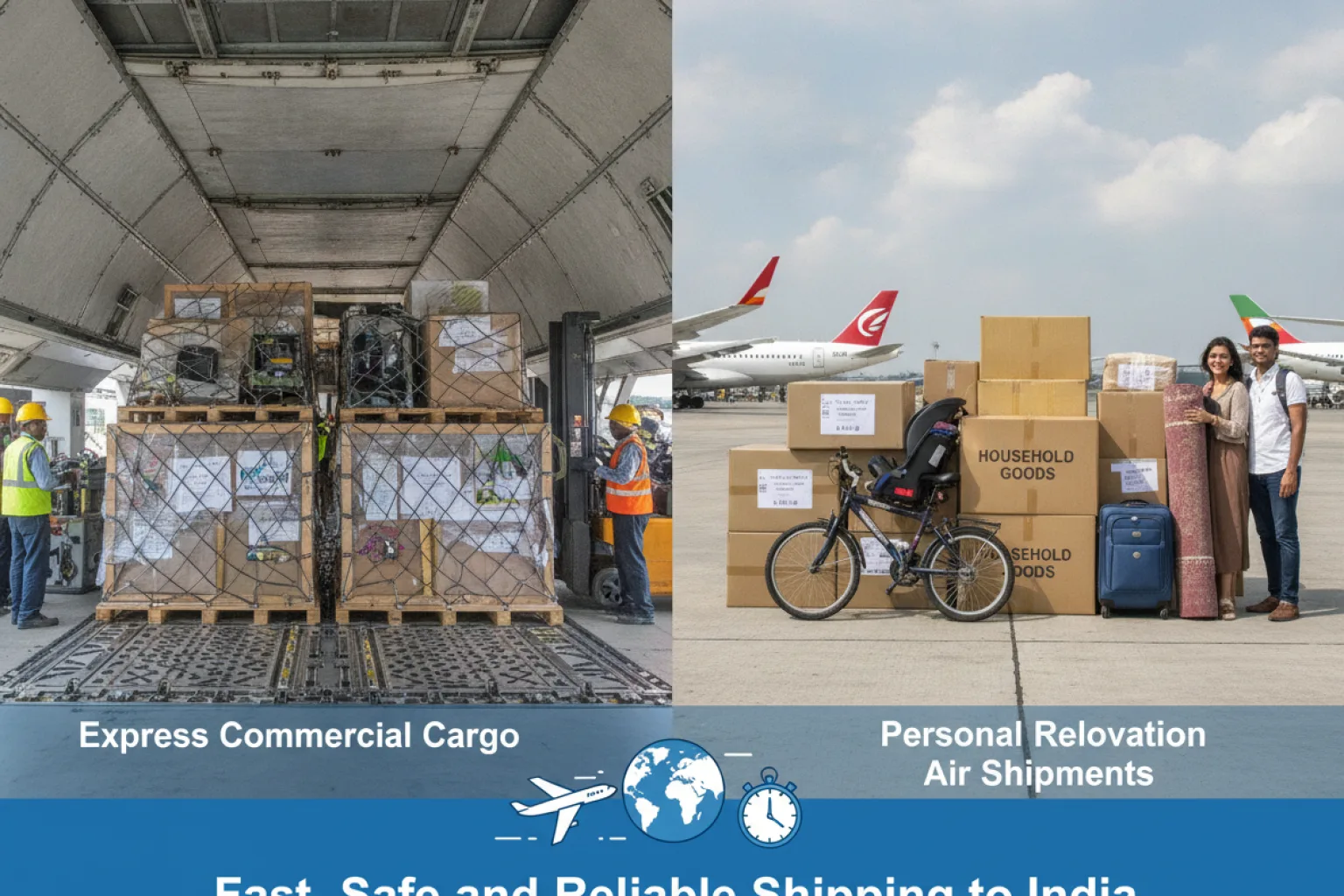
Whether you are dispatching factory components or packing up a family home, the operational playbook changes dramatically based on your cargo’s legal classification. Here is how two entirely different shipments cleared Indian air terminals without racking up massive storage bills.
Case A: Time-Critical Microchips to Bengaluru
An electronics OEM needed to move a 450 kg batch of electrostatic-sensitive microchips from Frankfurt to Bengaluru. To balance budget and speed, their logistics team bypassed dedicated charter services and chose scheduled consolidated air freight.
The shipment touched down at Kempegowda International Airport (BLR) and cleared customs in under 96 hours. The secret? Filing the prior Bill of Entry 24 hours before wheels-down and pre-submitting precise BIS (Bureau of Indian Standards) exemption certificates. The cargo never sat on the humid tarmac, heading straight to a temperature-controlled freight shed.
Case B: NRI Relocation to Hyderabad under Transfer of Residence
A software engineer returning permanently from the UK used India’s Transfer of Residence (TR) rules to air-freight 320 kg of high-value personal effects to Rajiv Gandhi International Airport (HYD).
Under TR rules (Customs Notification No. 27/2016), he claimed duty-free entry on used household items by proving a continuous stay abroad exceeding two years. The shipment included an expensive espresso machine and audio gear.
| Factor | Commercial Freight (Case A) | Household Relocation (Case B) |
|---|---|---|
| Primary Hurdle | BIS compliance & HSN classification | Proof of stay & used vs. new distinction |
| Clearance Clock | Immediate (prior-entry filing) | Starts after passenger lands in India |
| Cost Trap | Line-item duty miscalculation | Port demurrage while gathering ID proofs |
What These Scenarios Teach Us
When you send cargo to India by air, ground storage fees (demurrage) start accumulating fast—often within 48 hours of arrival.
- Pre-clear documents before departure: Have your broker vet commercial invoices or TR checklists while freight is still at the origin hub.
- Work with an IATA-certified agent: Certified forwarders hold direct air waybill inventory, so your paperwork does not get stalled behind third-party middlemen when Indian customs flags an inspection.
Common Mistakes to Avoid When You Send Cargo to India by Air
Even a tiny paperwork slip can leave your shipment stranded in a bonded warehouse at Mumbai or Delhi airport, racking up demurrage fees by the hour. Indian Customs (ICEGATE) runs on precision. If you want to send cargo to India by air without costly delays, steer clear of these four frequent missteps.
1. Guessing your HS codes
Using a generic six-digit Harmonized System (HS) code instead of the precise eight-digit Indian tariff classification is asking for trouble. If your code points to a lower basic customs duty (BCD) than what the appraiser determines, customs flags it as deliberate misdeclaration. You face reassessment, steep penalties, and a formal hold.
2. Under-declaring commercial samples and gifts
Marking an invoice as “gift—value $10” to dodge the Integrated Goods and Services Tax (IGST) rarely works. Appraisers cross-check product models against international market databases. Once a shipment is flagged for undervaluation, clearing it requires back-and-forth bank payment proofs and revised invoices, stalling release for weeks.
3. Packing hidden dangerous goods
Air cargo operates under strict IATA Dangerous Goods Regulations (DGR). Common retail items that seem harmless will trigger groundings if declared as general cargo:
- Standalone lithium-ion power banks (strictly forbidden on passenger flights and heavily restricted on cargo freighters)
- Aerosol sprays and perfumes (flammable liquids and gases requiring UN-spec packaging and dangerous goods declarations)
- Chemical reagents or paints packed without valid Material Safety Data Sheets (MSDS)
4. Buying the wrong insurance scope
Many shippers assume standard transit insurance covers everything from origin to the consignee’s door. It often doesn’t.
| Policy Type | Where Protection Stops | Hidden Risk |
|---|---|---|
| Door-to-Airport | Unloading at Indian tarmac/cargo terminal | Zero coverage for theft or damage during local road transit |
| Door-to-Door | Final signature at the consignee’s warehouse | Covers bumpy domestic trucking and warehouse handoffs |
If your consignee handles the final pickup from the airport, door-to-airport works fine. Otherwise, skimping on door-to-door coverage leaves your high-value freight exposed during the roughest leg of the trip: domestic road freight.
FAQS
How long does it take to send cargo to India by air?
Expect your shipment to land in 3 to 7 business days, depending heavily on whether you choose a direct or consolidated route. Direct flights touch down in hours, but customs processing at major hubs like Mumbai (BOM) or Delhi (DEL) dictates the real timeline. During peak holiday seasons like Diwali, terminal backlogs can stretch clearances by an extra two days.
| Service Level | Typical Transit | Best For |
|---|---|---|
| Express Air | 2–4 business days | Urgent parts, legal samples, critical stock |
| Standard Air Freight | 5–8 business days | Bulk commercial goods, planned freight |
What documents do I need to send cargo to India by air?
Indian customs won’t budge on paperwork; a single typo in a consignee name can leave your pallet stuck in a bonded warehouse racking up demurrage fees.
To smoothly send cargo to India by air, you will need:
- Air Waybill (AWB): The master tracking document and contract with the carrier.
- Commercial Invoice & Packing List: Detailing exact item counts, values, weights, and country of origin.
- Import Export Code (IEC): Mandatory for commercial shipments into India.
- KYC Documents: For personal effects, Indian customs requires verified ID proof (like an Aadhaar or passport) from the recipient before release.
Always match the HSN (Harmonized System of Nomenclature) code on your invoice to the physical goods. Misclassification triggers automatic manual inspection.
Is air freight to India safe for fragile or high-value items?
Yes, it is substantially safer than ocean transit because it cuts handling touchpoints and avoids weeks of humid marine conditions. However, pressurized cargo holds and severe tarmac turbulence present their own risks.
For high-value electronics or delicate instruments, never rely on standard factory cartons. Use shock-absorbing foam, double-wall corrugated boxing, and crate items on heat-treated pallets. Most importantly, ensure your cargo insurance covers the landed value (CIF + duty), not just the carrier’s baseline liability limit.
Conclusion
Choosing to send cargo to India by air comes down to balancing speed against your margins. If you are moving high-value inventory, urgent industrial parts, or time-sensitive samples, flight transit pays for itself. But it only works smoothly if you treat paperwork as seriously as packaging.
Most airport hold-ups in Delhi, Mumbai, or Bengaluru have nothing to do with airline mechanics. They happen at customs. A missing KYC document, a generic description like “machine spare” instead of the exact part name, or a mismatched commercial invoice can stall a pallet in the cargo terminal for days.
Before booking, make an honest assessment of whether air freight fits your cargo:
| Shipment Profile | Best Mode | The Deciding Factor |
|---|---|---|
| Under 100 kg, time-critical, or high value-to-weight | Air Freight | Transit takes 3–7 days; low capital lockup |
| Heavy machinery (>500 kg), low-margin bulk goods | Ocean Freight | Air rates become cost-prohibitive per kilo |
If you need your goods to arrive within a week without surprises, run through this quick pre-flight sanity check:
- Match your invoices to the letter: Ensure the declared item values match wire transfers or purchase orders to avoid customs re-assessment penalties.
- Verify the consignee’s credentials: The receiver in India must have an active IEC (Import Export Code) and updated GST registration before the plane takes off.
- Factor in chargeable weight: Remember that airlines bill on whichever is higher: the actual scale weight or the volumetric size. Repack loose boxes to avoid paying for empty space.
When timelines leave no room for ocean transit, air delivery remains your best bet—just make sure your documentation is as tight as your cargo straps.