
How Much Does It Cost to Send Cargo to Australia from the UK?
Moving goods halfway around the world rarely comes with a flat price tag. If you need to send cargo to Australia from the UK, your final invoice hinges on how fast you need it there and how much space your crates occupy. Below, we’ll break down the baseline rates, decode hidden logistics fees, and explain how carriers calculate what you actually owe.
Air and ocean freight serve entirely different budgets and timelines. If you’re moving a pallet of spare parts quickly, air is your best bet, while ocean consolidation works best for heavier, flexible inventory.
| Freight Mode | Typical Rate Benchmark | Best Suited For |
|---|---|---|
| Air Freight | £4.50 – £9.00 per kg | Urgent freight, high-value goods under 100 kg |
| Sea Freight (LCL) | £150 – £350 per CBM | Bulky shipments, non-perishables, moving house |
Watch out for volumetric weight—the industry’s way of ensuring light, bulky boxes don’t fly cheaply. Airlines calculate this using the formula $(L \times W \times H\text{ in cm}) / 5000$ (or $/6000$ for standard couriers). If your actual crate weighs 15 kg but takes up 35 kg worth of physical space, you will pay for 35 kg. Ocean freight uses a similar “weight or measurement” rule, billing per cubic metre (CBM) or metric tonne—whichever is larger.
The base freight rate is only part of the bill. When comparing freight quotes, always check whether these local surcharges are rolled into the total:
Terminal Handling Charges (THC)
Charged by origin and destination ports to move containers off the vessel.
Bunker & Fuel Surcharges (BAF/FSC)
Floating fees adjusted monthly based on global oil prices.
Documentation & Export Clearance
Usually £40–£90 for filing the single administrative document (SAD) in the UK.
Finally, consider the handover point. A port-to-port quote to Sydney, Melbourne, Brisbane, or Fremantle looks dirt-cheap on paper. However, unless you have an Australian customs broker and a local haulier ready on the quay, opting for a door-to-door service prevents costly port storage penalties while your paperwork clears biosecurity.
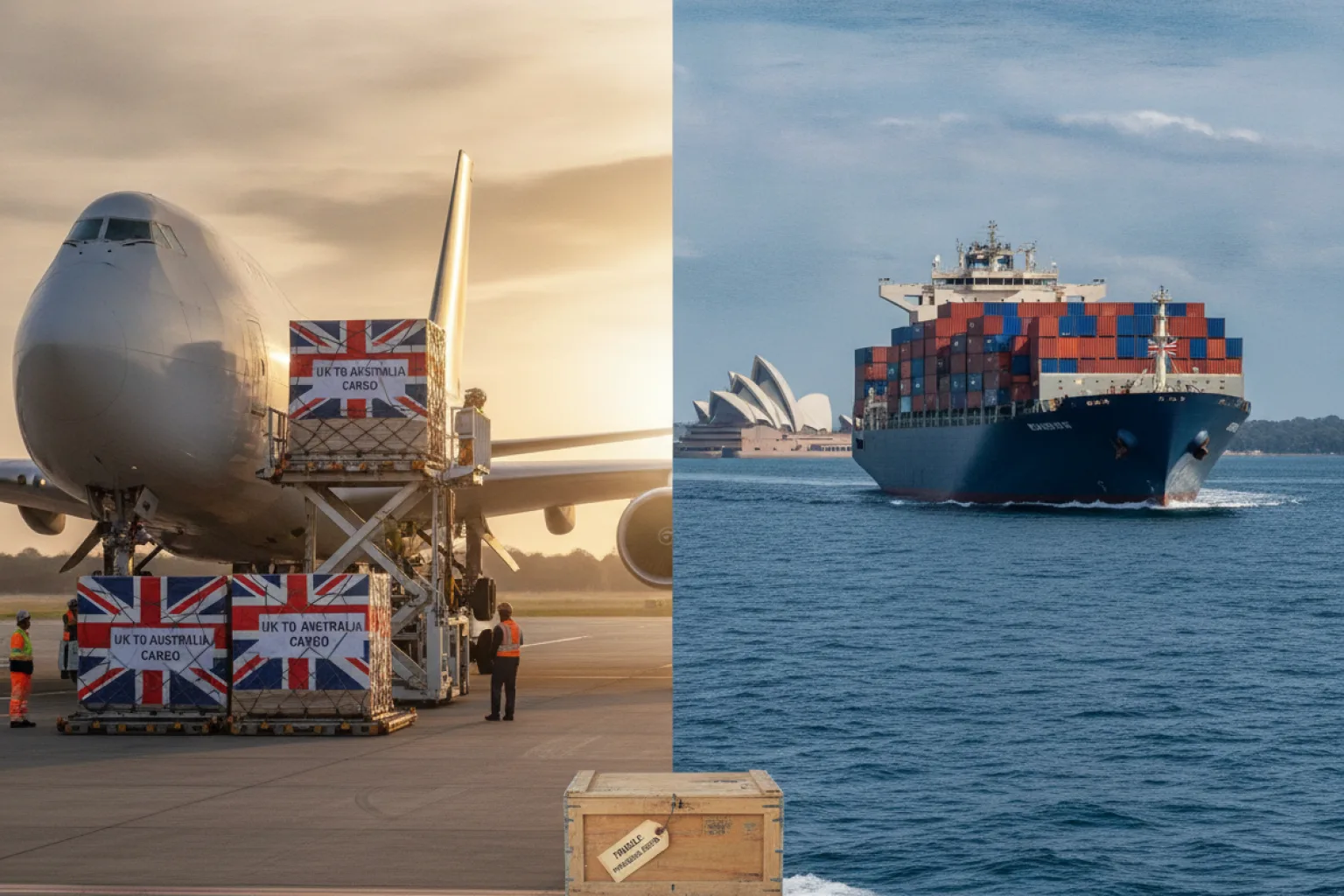
Air Freight vs. Ocean Freight: Choosing the Right Transport Mode
Deciding between sea and skies usually boils down to two things: your deadline and your volume. When you plan to send cargo to Australia from UK hubs, you are moving goods halfway around the planet, meaning the trade-offs between speed, cost, and emissions are stark.
Speed vs. Capacity
Air cargo gets your goods into Sydney, Melbourne, or Perth in roughly 3 to 7 business days. Ocean freight leaving ports like Felixstowe or Southampton takes anywhere from 40 to 60 days once you factor in transit, port congestion, and customs clearance down under.
For ocean transit, you will need to choose between two methods:
LCL (Less than Container Load)
Your items share a container with other shippers’ cargo. It is ideal for shipments between 2 and 12 cubic metres, though consolidation adds a few days on each end.
FCL (Full Container Load)
You hire an entire 20ft (about 33 cbm) or 40ft (about 67 cbm) steel container. It offers better security, cheaper unit economics for high volumes, and faster unloading.
| Mode | Typical Door-to-Door Transit | Best Suited For | Environmental Impact |
|---|---|---|---|
| Air Cargo | 3–7 business days | High-value electronics, medical stock, tight deadlines | High CO₂ emissions per kg |
| Ocean (LCL) | 45–65 days | 2–10 pallets, smaller business stock, mid-sized moves | Moderate |
| Ocean (FCL) | 40–55 days | Full house moves, bulk commercial retail goods | Lowest carbon footprint per tonne |
Making the Financial Call
Air freight relies on “chargeable weight” (a mix of gross weight and bulk). If a London design house needs to get ten lightweight product samples to a Melbourne trade buyer before next Monday, paying for priority air cargo is cheap insurance against a blown commercial deal.
Conversely, if you are relocating and have 250kg of books, heavy winter clothes, and kitchenware, booking air freight will trigger an eye-watering invoice. Shifting that volume to an LCL sea shipment slashes the bill by hundreds of pounds, provided you plan two months ahead.
Beyond cost, consider the cargo itself. Temperature-sensitive pharmaceuticals and fragile components do far better on a smooth, climate-managed flight. Sturdy furniture, raw materials, and non-perishables are built for the long water route.
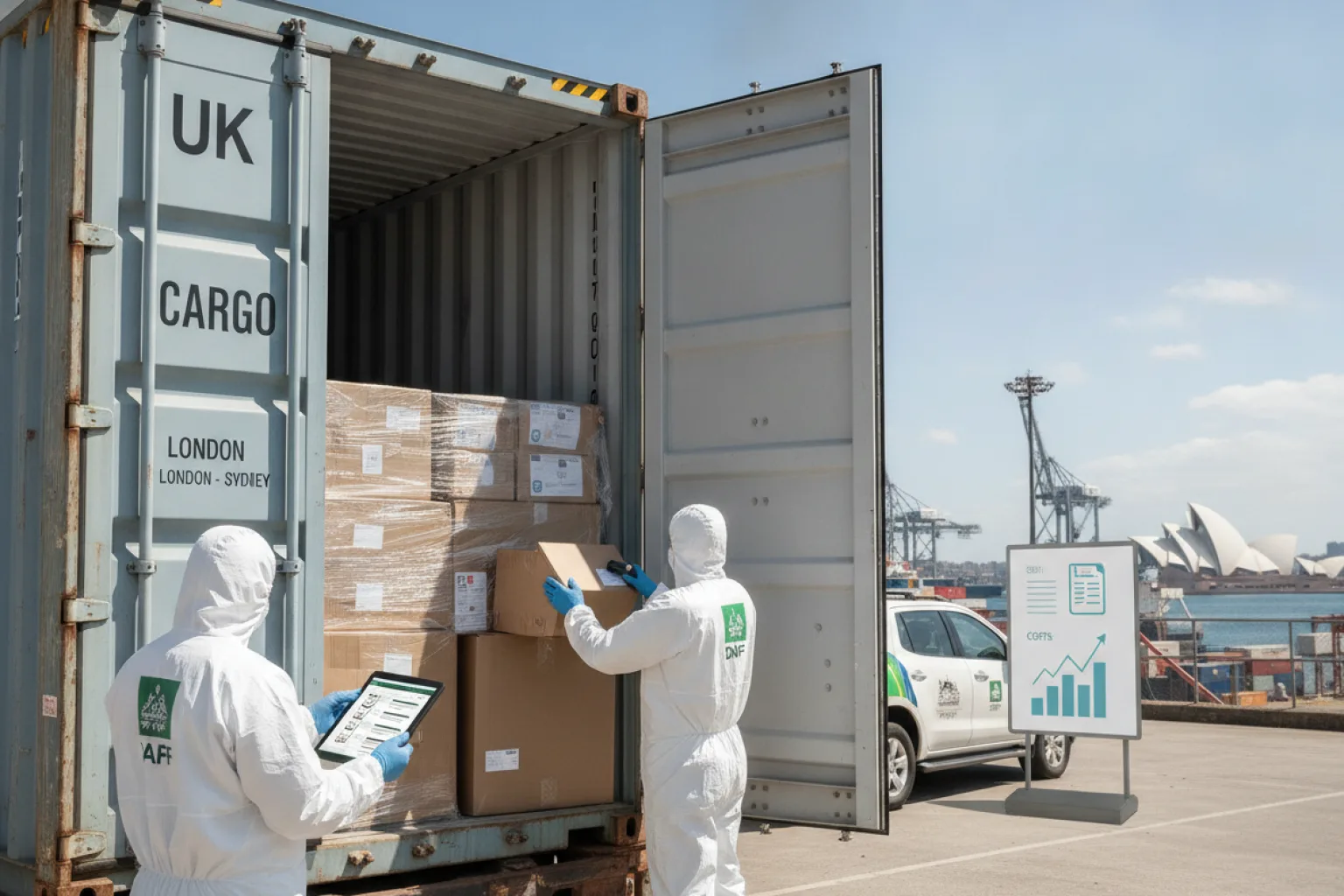
Strict Biosecurity Rules: What the Australian Department of Agriculture (DAFF) Checks
Australia takes border biosecurity more seriously than almost any other nation on earth. When you send cargo to Australia from UK ports, your consignment does not just clear standard customs—it faces inspection by the Department of Agriculture, Fisheries and Forestry (DAFF).
Before packing a single box, check the BICON (Biosecurity Import Conditions) database. This live portal outlines exactly what can enter, what needs an import permit, and what treatment certificates are non-negotiable. Skipping this step is the fastest way to get your shipment impounded.
DAFF operates on zero-tolerance rules for organic contaminants. Solid wooden packing crates, pallets, and dunnage must carry an authentic ISPM 15 stamp certifying heat treatment or methyl bromide fumigation; processed woods like plywood or MDF are generally exempt. Beyond packaging, raw plant matter, seeds, pinecones, untreated feathers, and raw animal products will trigger instant red flags.
Outdoor personal effects pose the biggest everyday risk:
Tents and camping equipment
DAFF officers look directly at the pegs and groundsheet creases for dried mud and grass seeds.
Bicycles and golf clubs
Treads, wheel arches, and iron grooves must be entirely spotless. A light wipe-down is not enough—use a pressure washer and a stiff brush.
Garden machinery
Mowers and strimmers must be completely drained of fluids and stripped of every trace of clippings and soil.
| Cargo Condition at Port | DAFF Action Taken | Commercial Impact |
|---|---|---|
| Spotless & ISPM 15 certified | Cleared for release | Standard release timeframe |
| Contaminated (minor soil/seeds) | Directed for onshore wash/fumigation | Depot fees, inspection bills, 5–10 day delay |
| Banned matter or severe infestation | Forced re-export or destruction | Massive carrier surcharges; goods destroyed at your expense |
If DAFF flags your container, the financial fallout sits entirely with you. A quarantine intervention easily adds hundreds of dollars in depot shifting and tailgate fees. If contaminants cannot be safely treated onshore, officers will order the cargo destroyed or returned to the UK at your expense. Clean thoroughly before packing; a second-hand tent with a smear of British mud simply is not worth a four-figure fumigation invoice.
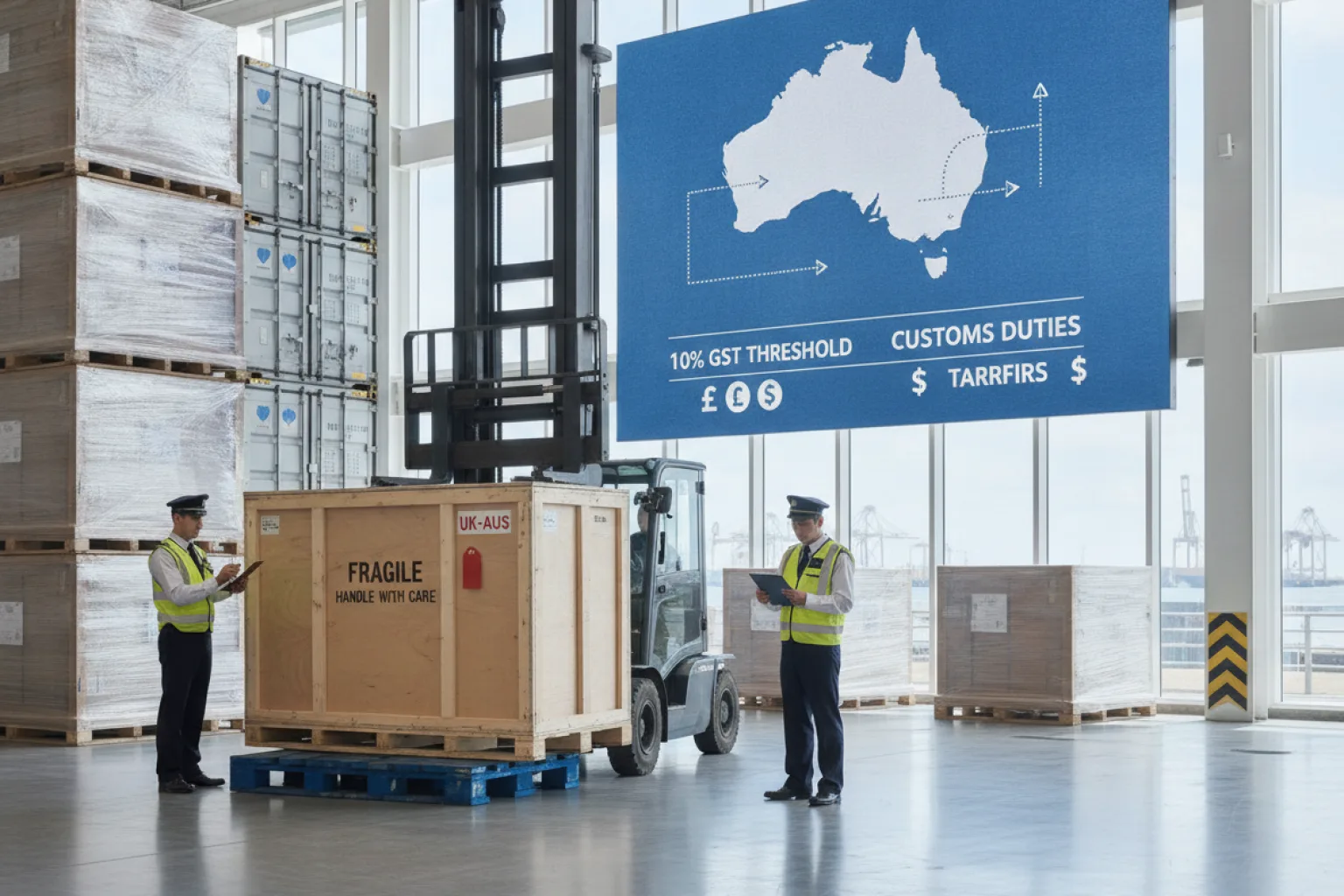
Australian Customs Regulations, Tariffs, and the 10% GST Threshold
Australian border clearance catches plenty of shippers off guard. The fundamental rule for importing into Australia hinges on the AUD $1,000 threshold. If the customs value of your consignment stays at or below AUD $1,000, it usually clears without import duty, though low-value goods may still attract the standard 10% Goods and Services Tax (GST) depending on how you purchased them. Cross that $1,000 line, however, and the process shifts: you are required to lodge a formal Import Declaration (FID) and pay both duty and GST unless a specific exemption applies.
If you plan to send cargo to Australia from UK ports as part of a home move, you shouldn’t pay retail import taxes on used belongings. You can claim relief through the Unaccompanied Personal Effects (UPE) concession under By-Law No. 1305417.To qualify, you must have owned and used the goods abroad for at least 12 months, and you must hold an eligible Australian permanent or temporary visa. Don’t try using UPE for commercial stock or brand-new household items still in factory boxes; the Australian Border Force (ABF) will quickly flag them.
| Entry Type | Value Threshold | Duty / GST Payable? | Key Requirement |
|---|---|---|---|
| Low-Value Cargo | Up to AUD $1,000 | GST may apply; Duty-free | Self-Assessed Clearance (SAC) declaration |
| Standard Import | Over AUD $1,000 | 5% Duty + 10% GST | Full Import Declaration (FID) |
| UPE Concession | No monetary cap | Zero Duty, Zero GST | By-Law 1305417; 12 months’ prior ownership |
Commercial shippers should look to the UK-Australia Free Trade Agreement instead. Under the FTA, most originating British goods enter tariff-free, but you must provide a valid Certificate of Origin or an origin declaration on your commercial invoice. Skipping this means defaulting to the standard 5% duty rate.
To keep your freight moving without manual holds, hand your forwarder a complete paperwork package before the ship departs:
Commercial Invoice
An itemised breakdown showing real values, currency, and exact material compositions.
Packing List & Packing Declaration
Clear carton-by-carton details, explicitly stating whether timber or straw packaging is present (critical for Biosecurity/DAFF).
Transport Document
Either your Ocean Bill of Lading or Air Waybill (AWB) showing matching consignee details.
Real-World Shipping Scenarios: Cost and Timeline Examples
Theoretical estimates rarely survive contact with port authorities. When you plan to send cargo to Australia from UK ports, the real variables come down to method, volume, and how tightly your paperwork matches what is physically inside the boxes.
Here is how two typical shipments play out in practice:
| Shipment Profile | Route & Method | Transit Time | Typical Landed Cost Breakdown |
|---|---|---|---|
| 2-Bed Flat Relocation (Personal effects, ~12 m³) | London to Melbourne via LCL ocean freight | 52 days port-to-door | £2,450 ocean freight + £480 destination port handling + £220 quarantine (BICON) inspection |
| 85kg Retail Textiles (5 master cartons) | Heathrow (LHR) to Sydney (SYD) via consolidated air | 5 days airport-to-door | £610 air freight + £85 airline handling + 10% GST on landed value + £90 broker entry |
The ocean move takes patience. The vessel spends weeks crossing the equator, where daytime heat and nighttime sea breezes create heavy condensation inside steel walls. If your goods sit in standard cardboard without moisture barriers, you risk cargo sweat ruin. Wrap upholstered furniture in breathable moving pads, line boxes with plastic sheeting, and toss in high-capacity desiccant packs before taping.
Paperwork errors cause most delays once the ship or plane lands. Both cases above run into strict scrutiny from the Department of Agriculture, Fisheries and Forestry (DAFF):
Vague cargo manifests
Writing “samples,” “merchandise,” or “gifts” triggers instant border holds. Write “100% woven cotton shirts” or “solid oak dining chairs.”
Missing manufacturer details
Commercial air shipments stall at customs if commercial invoices lack the full manufacturing origin and business name.
Dirty outdoor gear
In personal moves, pack boots and garden tools last so you can access them easily. If biosecurity officers spot a speck of British topsoil on a hiking boot tread, expect a mandatory £150+ wash fee and a week-long quarantine delay.

Step-by-Step Checklist to Send Cargo to Australia from UK Successfully
Shipping freight halfway across the world rarely goes wrong on the open water. It goes wrong on the driveway or at the quarantine dock. To send cargo to Australia from UK ports without surprise bills, work backward from your moving date using this timeline.
8 Weeks Out: Scrutiny and Sourcing
Start with a strict audit. Australia’s Department of Agriculture, Fisheries and Forestry (DAFF) runs one of the toughest biosecurity borders on earth. Check their BICON database before packing a single box. Untreated wicker furniture, dried flower arrangements, or garden tools carrying English soil will either be steam-cleaned at your expense or incinerated. Gather at least three quotes from international freight forwarders, comparing full-container (FCL) versus shared-container (LCL) rates.
4 Weeks Out: Packaging and Paperwork
Australian customs will reject uncertified timber instantly. If you use timber pallets or timber crates, ensure they carry the ISPM-15 wheat stamp showing heat-treatment. Otherwise, stick to brand-new, double-walled corrugated cardboard boxes. Fill out your Australian Customs Form B534 (Unaccompanied Personal Effects Declaration) now. Be painfully specific; writing “miscellaneous kitchenware” invites a manual inspection, while “stainless steel cutlery and boxed dinner set” sails through.
1 Week Out: Weigh-ins and Cover
Measure every crate down to the millimetre. Freight companies calculate cost by volumetric weight, and catching discrepancies before collection prevents sudden surcharges. Sort your transit cover now—standard terms won’t cut it for a seven-week voyage.
| Cover Type | What It Actually Covers | Real-World Risk |
|---|---|---|
| Carrier Liability | Negligence only (often capped per kg) | Pays pennies if a crate drops overboard |
| All-Risk Marine Policy | Total loss, water ingress, rough sea damage | Higher upfront premium, full replacement value |
Tape waterproof, smudge-proof labels to at least two sides of every package.
Arrival: Clearing the Gates
Once your vessel docks in Sydney, Melbourne, or Fremantle, track its release via the forwarder’s portal. Budget ahead for destination terminal handling charges (DTHC), port security fees, and DAFF clearance fees. If biosecurity officers flag an item for physical inspection, you will pay their hourly inspection rate, so clean outdoor gear spotlessly in the UK to clear the gate on the first pass.
FAQS
How long does it take to send cargo to Australia from the UK?
Air freight typically lands in major hubs like Sydney or Melbourne within 4 to 8 days, door-to-door.
Ocean freight is a waiting game. Expect 45 to 60 days for a full container (FCL), but if you share space in a consolidated box (LCL), tack on an extra two weeks for packing at Southampton or Tilbury and customs deconsolidation in Australia. Weather quirks around the Cape of Good Hope or port congestion at Fremantle can easily throw an extra week into your timeline.
| Transport Mode | Typical Transit Window | Best Suited For |
|---|---|---|
| Air Freight | 4–8 business days | Pallets under 300kg, urgent parts, high-value goods |
| Ocean (FCL) | 45–55 calendar days | Full house moves, bulk commercial stock |
| Ocean (LCL) | 55–70 calendar days | 1–5 pallets, non-urgent heavy cargo |
How much does it cost to send cargo from the UK to Australia?
Pricing changes weekly based on bunker fuel and carrier capacity, but the route you pick matters more than the gross weight.
Air cargo generally runs between £4.50 and £9.00 per kilo, with cheaper per-kilo breaks once you cross the 500kg threshold. Sea freight works on volume (cubic metres). Budget roughly £150 to £280 per CBM for LCL shipping.
Don’t forget the hidden terminal fees. Your ocean quote might look cheap at first glance, but Australian port charges, import processing fees, and delivery cartage at the destination routinely double the initial shipping figure.
What items can’t I send in cargo from the UK to Australia?
The Australian Department of Agriculture, Fisheries and Forestry (DAFF) runs the strictest border checks in the world to protect local ecosystems.
Skip packing anything that has touched soil or farm fields without professional cleaning. Common cargo traps include:
Untreated raw timber
Crates or pallets lacking an ISPM-15 heat-treatment stamp will get turned around or incinerated at your expense.
Organic materials
Feathers, dried flowers, pinecones, untreated straw, and seeds.
Hazardous consumer goods
Loose lithium-ion battery banks, aerosols, and uncleaned petrol-powered garden tools (even a faint petrol whiff triggers an immediate quarantine hold).
When in doubt, declare it on your packing manifest. Border officials will penalise undeclared organic goods far more aggressively than items marked for routine inspection.
Conclusion
Getting your shipment across the globe doesn’t have to turn into an administrative nightmare, but it does punish wishful thinking. When you plan to send cargo to Australia from UK ports or airports, your biggest risk isn’t the physical distance—it’s getting caught off guard by quarantine fees, port congestion, or sloppy documentation.
The right choice always boils down to a classic trade-off between cash flow and lead times. If you have a few boxes of personal effects or critical machinery parts, air freight spares your sanity. If you’re relocating a three-bedroom house or moving commercial inventory by the pallet, ocean freight is the only way to protect your margins.
Here is how those practical trade-offs look on the ground:
| Shipment Profile | Best Mode | The Realistic Trade-Off |
|---|---|---|
| Under 100 kg / high urgency | Direct Air Cargo | High cost per kilo; clears customs rapidly in Sydney or Melbourne. |
| 1–10 CBM / flexible deadline | LCL (Shared Ocean Container) | Lowest cost for small freight; double handling can cause warehouse delays. |
| Full household / commercial volume | FCL (Sole-Use 20ft/40ft Box) | Predictable port-to-port transit; requires upfront packing space and drayage fees. |
Whatever route you pick, treat Australia’s biosecurity rules as absolute law. Don’t throw untreated timber pallets or uncleaned garden tools into a container thinking no one will notice; the Department of Agriculture, Fisheries and Forestry (DAFF) will spot them, order a mandatory fumigation, and hand you the bill.
Before booking:
Verify timber standards
Ensure any wood packaging carries the ISPM 15 stamp.
Scrub outdoor gear
Pressure-wash mowers, boots, and camping equipment until zero dirt remains.
Lock down line-item quotes
Confirm your forwarder’s quote includes Australian terminal handling charges (THC), not just UK collection.
A smooth delivery usually comes down to doing the boring prep work before the cargo leaves your driveway. Take the extra afternoon to pack precisely, declare honestly, and let your freight forwarder handle the logistics while you focus on the rest of your move or business pipeline.