
How Air Freight vs Ocean Freight Costs Are Calculated When Shipping to Canada
If you need to send cargo to Canada, the price on a carrier’s quote sheet is rarely the number you actually pay. Freight pricing is notoriously murky, and a rate that looks cheap on paper can balloon once port surcharges, fuel spikes, and dimensional formulas kick in. Below, we break down how carriers bill your shipments, the line-item fees to watch out for, and how to choose the right mode for your timeline.
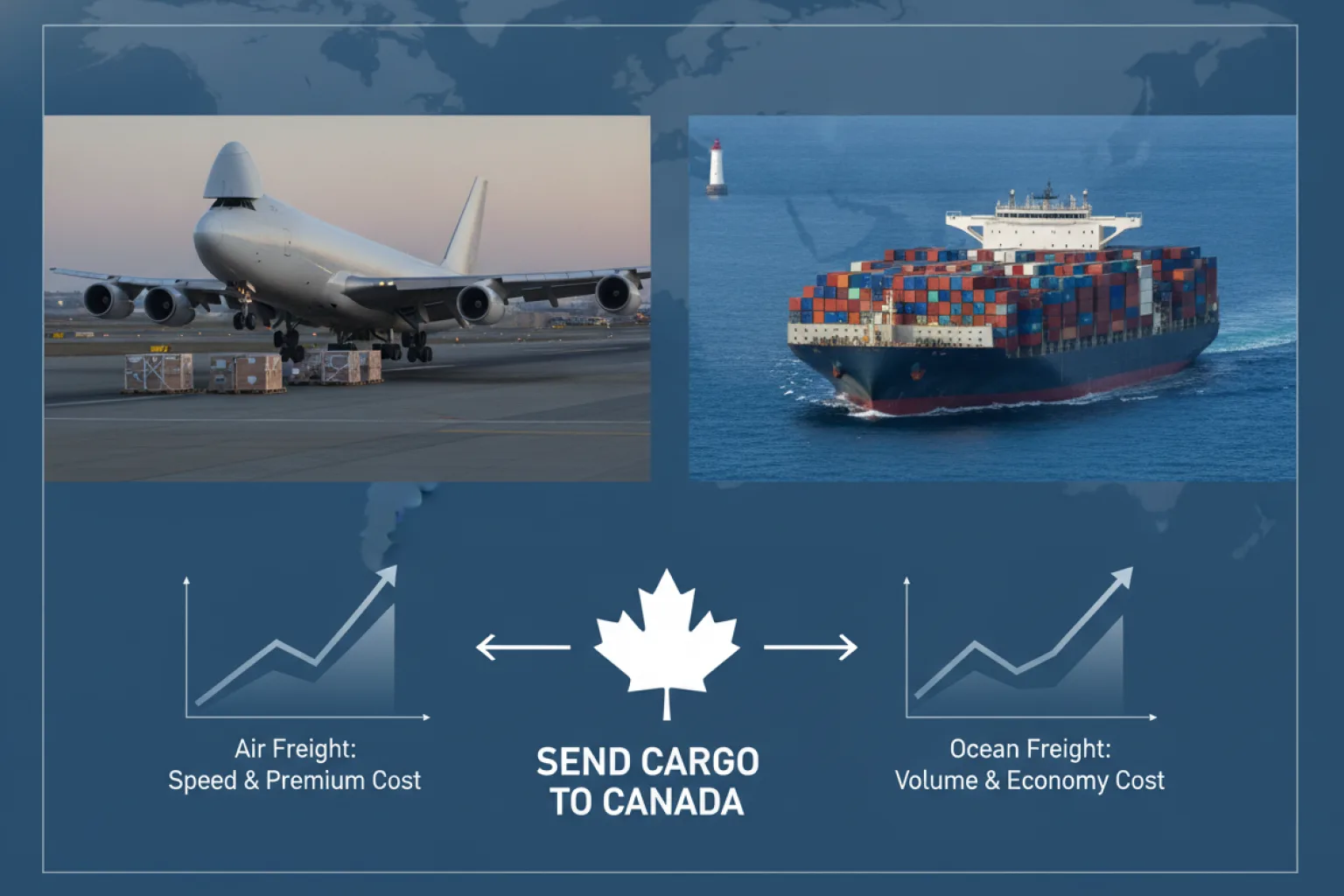
The core difference comes down to space versus lift. Airlines bill on chargeable weight—a volumetric formula (length × width × height in cm ÷ 6,000) compared against the actual scale weight, with the carrier charging whichever is higher. If you ship lightweight down jackets, you pay for the volume they displace, not their actual weight.
Ocean freight plays by different rules. For Less than Container Load (LCL), freight forwarders bill strictly by cubic meter (CBM) or revenue ton. For Full Container Load (FCL), you buy the box outright (a flat box rate) regardless of how full it is, provided you stay under statutory road-weight limits upon Canadian arrival.
| Pricing Metric | Standard Air Cargo | Ocean LCL | Ocean FCL (20’/40′) |
|---|---|---|---|
| Billing Basis | Chargeable weight (kg vs. volume) | Volume (per CBM / 1,000 kg) | Flat rate per container |
| Primary Hubs | YYZ (Toronto), YUL (Montreal) | Vancouver (Port Metro), Montreal | Vancouver, Prince Rupert, Halifax |
| Transit Speed | 3–7 business days | 20–35 days | 14–30 days |
Base rates only tell half the story. Always audit your quote for standard ancillary charges:
Terminal Handling Charges (THC)
Port or airport equipment fees for offloading and staging your freight.
Bunker Adjustment Factor (BAF) / Fuel Surcharge
Floating fuel offsets tied to crude oil fluctuations.
Currency Adjustment Factor (CAF)
Currency risk buffers applied when freight lines invoice between USD and CAD.
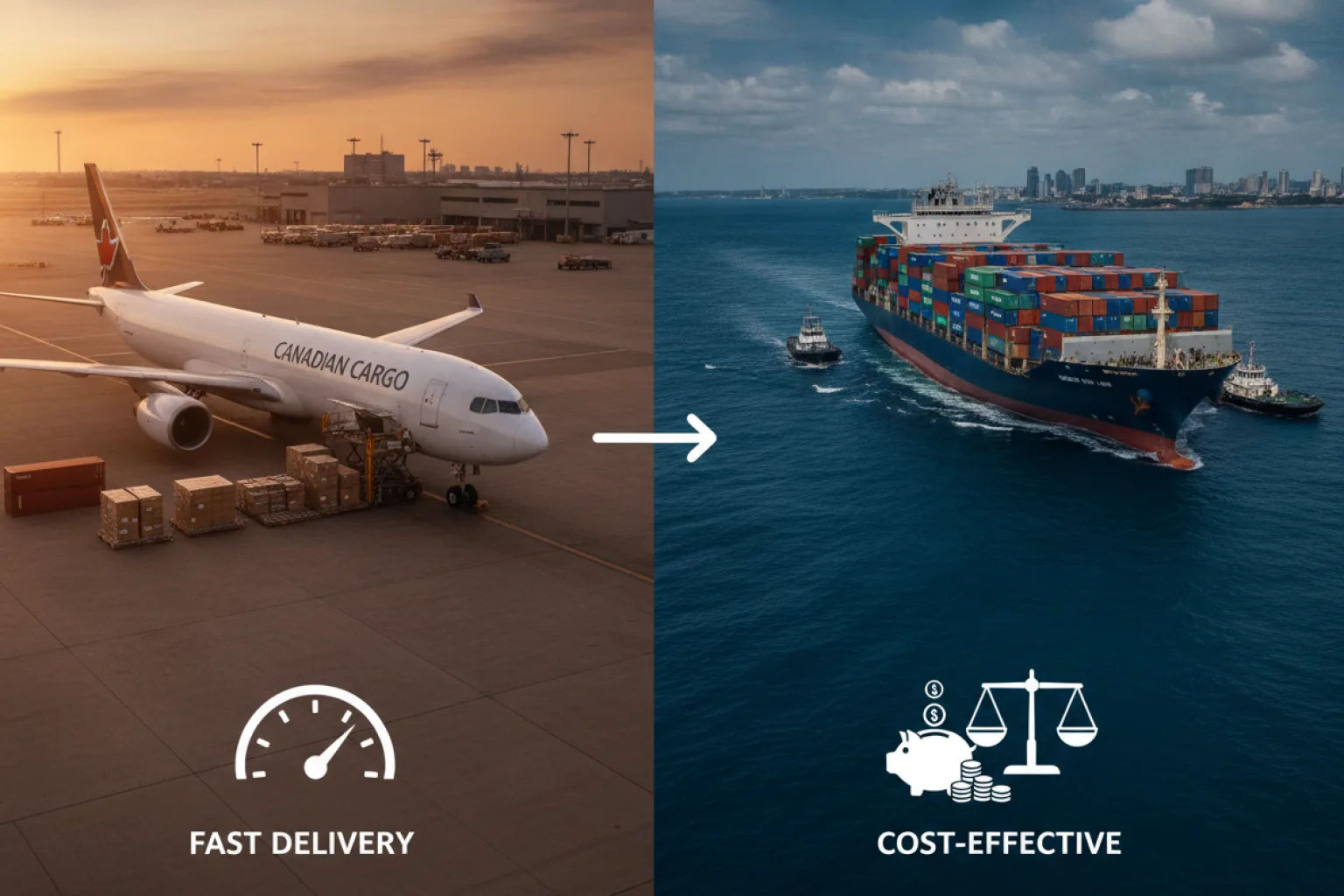
Use air when product margins and shelf-life justify the burn—think electronics launches, urgent auto components, or temperature-sensitive pharmaceuticals. But for bulk inventory replenishment where lead times allow flexibility, ocean shipping protects your operating margins every single time.
Step-by-Step Guide to Clearing Canadian Customs Without Costly Delays
Clearing customs in Canada doesn’t have to eat up your margins, but a single missing document can leave your freight stranded on the tarmac at Pearson or sitting in a Vancouver container yard racking up storage fees.
To keep your shipment moving, get your paperwork sorted before you send cargo to Canada. The Canada Border Services Agency (CBSA) requires four core records:
Canada Customs Invoice (CCI)
or a commercial invoice containing the exact same data fields (vendor, purchaser, country of origin, and an itemized price breakdown).
Bill of Lading (BOL)
or Air Waybill, handed off by your carrier.
Packing slip
showing piece counts, gross and net weights, and package markings.
Permits or certificates
if you move regulated goods like food, cosmetics, or batteries.
Next comes classification. Never guess your tariff code. Under CBSA rules, you need an exact 10-digit Harmonized System (HS) code—the first six digits are international, while the final four are specific to Canadian duty and statistical tracking. A mistake here means either overpaying duties or facing penalties under the Administrative Monetary Penalty System (AMPS).
You must also register on the CARM Client Portal (CBSA Assessment and Revenue Management). Commercial importers now handle accounting, payments, and release security directly through CARM. If you want release prior to payment (RPP)—which lets your cargo clear before duties are settled—you have to post your own financial security (either a cash deposit or a continuous customs bond) inside the portal. Skipping this step means your broker cannot clear the goods on their account, and your freight stops dead at the border.
Here is a quick look at how the numbers shake out for a typical cross-border arrival:
| Cost Component | 500 kg Electronics (YYZ Clearance) | Calculation / Source |
|---|---|---|
| Declared Value | $20,000 CAD | Commercial Invoice |
| Duty Rate | 0% | HS 8471.30 (ITA Agreement) |
| Federal GST | $1,000 CAD | 5% on value for duty |
| Customs Brokerage | ~$175 CAD | Base clearance fee |
| Total Import Costs | $1,175 CAD | Taxes + broker charges |
Note: Provincial sales tax (PST or HST) is generally settled downstream via your regular tax returns rather than right at the port of entry for commercial imports.

Real-World Freight Scenarios: Which Shipping Method Delivers the Best ROI?
Return on investment in freight rarely comes down to the cheapest carrier quote. True ROI balances inventory carrying costs and stockout penalties against actual transit spend. To see how this works when you send cargo to Canada, let’s look at two familiar scenarios we see on the logistics floor every week.
Scenario A: The Margin Protector (LCL Ocean)
An apparel brand in Montreal orders 1.5 CBM of wool knitwear from Portugal. The shipment weighs roughly 320 kg with a wholesale value of $9,000.
Air freight would eat almost 25% of their total gross margin. Instead, they book Less-than-Container Load (LCL) ocean freight into the Port of Montreal. The cargo takes 24 days door-to-door, but freight costs stay under $650 all-in. Because the inventory was ordered eight weeks before autumn retail demand kicked in, the longer transit had zero negative impact on revenue. Ocean won on pure landed-cost efficiency.
Scenario B: The Emergency Save (Expedited Air)
An automotive tier-1 supplier in Windsor, Ontario, faces a defective batch of specialized sensor brackets sitting in Germany. Their assembly client charges a downtime penalty of $18,000 per hour if the line goes dark.
Ocean freight wasn’t even on the table. The logistics manager booked an express air charter service at a painful $11,500 for two pallets. The cargo cleared customs at Toronto Pearson (YYZ) and reached the factory floor in under 40 hours. Spending five figures on air freight saved the supplier over $140,000 in contractual plant shutdown fines.
| Priority Driver | Optimal Mode | Typical Door-to-Door Transit | Best Fit When… |
|---|---|---|---|
| Landed Cost | LCL / FCL Ocean | 20–45 Days | Cargo volume > 1 CBM and lead times allow buffer for port congestion. |
| Line-Down Risk | Express Air | 3–7 Days | Margin loss per day exceeds the 4x–6x price premium of flight space. |
Factoring in Canadian Seasonal Spikes
Even the cleanest math breaks down if you ignore the calendar. When planning budgets to send cargo to Canada, watch out for three seasonal traps:
Pre-Holiday General Rate Increases (GRIs)
August through October ocean space tightens drastically ahead of retail peak, causing ocean rates to jump 30% to 50% without warning.
Winter St. Lawrence Freezes
Icy conditions and winter navigation surcharges slow down East Coast waterways between December and March, pushing more freight onto rail networks that easily bottleneck.
West Coast Labor Friction
Contract talks at ports like Vancouver and Prince Rupert regularly spark brief rail or dock slowdowns. If you spot union friction in the headlines, route urgent inventory via air immediately rather than gambling on a floating container.
Costly Mistakes Importers Make When Shipping Freight to Canadian Ports
Moving ocean containers across the Pacific or Atlantic looks simple on paper until your box docks in British Columbia or Quebec. When you send cargo to Canada, rookie supply chain blunders do not just cause slight delays—they trigger massive port fines and cross-border tax headaches.
Here are the four missteps that drain commercial margins the fastest:
1. Defaulting to DDP Without a Business Number
Sellers often default to Delivered Duty Paid (DDP) to give their buyers an easy experience. But Canada Revenue Agency (CRA) rules are strict. If you are the exporter and choose DDP without an active Canadian Business Number (BN) and an import/export program account, the Canada Border Services Agency (CBSA) will freeze the shipment at the frontier. You cannot act as the Non-Resident Importer (NRI) on record or pay duties legally, leaving cargo stranded while carrier detention clocks tick away.
2. Overlooking Wood Pallet Regulations (ISPM 15)
CBSA officers inspect dunnage and wood packaging closely. If your supplier in Asia or Europe loads your goods onto raw, untreated lumber that lacks the heat-treated or methyl bromide ISPM 15 stamp, there are no second chances. Canadian ports will not allow you to re-palletize on the dock; they will order the entire container re-exported at your expense immediately.
3. Miscalculating Regional Tax Surprises
Federal tariffs are only half the battle. Importers consistently blow their landed-cost forecasts by forgetting that Canadian sales taxes vary wildly by the final destination province:
| Destination Province | Applicable Tax at Import/Delivery | Combined Rate |
|---|---|---|
| Alberta | GST only | 5% |
| Ontario | HST | 13% |
| British Columbia | GST + PST | 12% |
| Quebec | GST + QST | 14.975% |
4. Ignoring Railheads and Terminal Demurrage
Congestion at the Port of Vancouver (Roberts Bank/Burrard Inlet) and the Port of Montreal rarely stays at the pier. If your cargo needs an intermodal transfer via CN or CPKC to reach Toronto or Calgary, an inland chassis shortage can leave your container sitting in the yard past your free-time window. At $200 to $400 a day per box in demurrage fees, a two-week rail bottleneck will obliterate whatever profit margin you secured by hunting down cheap ocean rates. Plan for at least five days of terminal buffer before confirming downstream delivery dates.
How to Choose the Right Freight Partner to Send Cargo to Canada at the Best Rates
Landing a low quote doesn’t mean much if your container sits stranded at the Port of Vancouver racking up demurrage fees. To reliably send cargo to Canada without surprise invoices, you need a logistics partner built for the country’s unique geography and regulatory quirks.
Start by interviewing freight forwarders on three non-negotiables:
Bonded carrier status
Can they move your goods past the border to an inland destination before clearing customs? If not, expect bottlenecks at your arrival port.
Rail contracts
Moving freight east from Prince Rupert or Montreal requires robust intermodal access. Ask specifically about their allocations on Canadian National (CN) and Canadian Pacific Kansas City (CPKC).
Cargo liability
Basic carrier liability pays pennies on the pound. Ensure they offer comprehensive primary cargo insurance that covers total loss during ocean crossings.
You also have to decide whether to book direct or use a forwarder’s consolidated volume.
| Route Type | Best For | Typical Threshold | Trade-Off |
|---|---|---|---|
| Direct Carrier Contract | High-volume shippers | 100+ TEUs per year | Cheaper per box, but zero inland hand-holding |
| Forwarder Consolidation | LCL and mid-sized FCL | Under 50–75 TEUs per year | Slightly higher baseline rate, but dynamic rail rerouting |
Unless you are pushing multiple containers every week, booking directly with an ocean line like Maersk or Hapag-Lloyd leaves you vulnerable when rail backlogs hit. Forwarders provide the operational buffer you need.
Finally, pair your transport with a CBSA-licensed customs broker. Under Canada’s CARM (CBSA Assessment and Revenue Management) portal, your business is directly accountable for classification errors. A sharp broker doesn’t just keep you compliant; they actively audit your commercial invoices to claim duty-free status under trade pacts like CUSMA, CETA, or CPTPP.
Ready to move? Lock in your final packing lists with exact weights, assign delegation of authority to your broker inside your CARM client portal, and hand off your commercial invoice for pickup scheduling.
FAQS
How long does it take to send cargo to Canada by air versus sea?
Air transit is swift, usually taking 2 to 7 business days door-to-door, depending on whether you book direct routing into hubs like Toronto (YYZ) or Vancouver (YVR). Ocean freight requires patience: expect 20 to 45 days on the water, plus an extra 5 to 10 days for inland rail transport to central provinces.
| Mode | Port-to-Port / Airport | Door-to-Door (with inland transit) | Best For |
|---|---|---|---|
| Air Freight | 1–3 days | 3–7 days | Under 300 kg, urgent stock, high value |
| Ocean (FCL/LCL) | 14–30 days | 25–50 days | Bulky goods, machinery, loads over 500 kg |
Weather delays in the North Atlantic or winter rail backlogs around Montreal can easily add a week to ocean moves, so build a buffer into your delivery promises.
What documents are required to clear Canadian customs?
The Canada Border Services Agency (CBSA) rejects paperwork with vague descriptions. “Electronics” won’t fly; you need specific line items like “unpopulated printed circuit boards.”
To ensure clean clearance, have your broker prep:
Canada Customs Invoice (CCI)
or a commercial invoice detailing buyers, sellers, and HS codes.
Bill of Lading (BOL)
for sea shipments or an Air Waybill (AWB) for air cargo.
Cargo Control Document (CCD)
generated by your carrier upon border arrival.
Certificate of Origin
crucial if you want preferential duty rates under trade agreements like CUSMA.
Is air or ocean freight cheaper to send cargo to Canada?
Ocean freight is almost always cheaper for large volumes, but it depends on your chargeable weight.
If your total shipment weighs under 100 kg, air freight often costs less once you factor in ocean handling: terminal charges, destination documentation fees, and minimum pallet rates quickly eat up sea savings. The financial tipping point sits around 300 to 500 kg. Above that threshold, ocean cargo delivers massive cost reductions, typically costing 70% to 80% less than flying your goods.
Conclusion
Picking the right method to send cargo to Canada ultimately comes down to a simple balance between shelf-life urgency and your landed cost per unit. Air freight wins when a factory shutdown in Ontario is burning money by the hour, or when high-value electronics need to bypass port congestion. But if your inventory can comfortably sit on the water for three to six weeks, ocean freight keeps your margins intact.
A common mistake shippers make is evaluating only the base freight rate. Remember that air cargo bills on chargeable weight (actual weight versus volumetric space), meaning light, bulky boxes can cost just as much as dense machinery. Conversely, sea freight carries port handling fees, documentation costs, and inland rail charges from coastal hubs like Vancouver or Montreal that can catch first-timers off guard.
Use this quick sanity check before booking:
| Cargo Scenario | Recommended Mode | The Operational Trade-Off |
|---|---|---|
| Under 150 kg (High-value or urgent) | Air Freight | Higher upfront cost; minimal port delays. |
| Over 2 CBM / 500 kg (Standard inventory) | Ocean (LCL/FCL) | Low transport cost; longer buffer needed for CBSA clearance. |
| Hazardous or oversized items | Ocean Freight | Strict airline limits avoid rejection; slower turnaround. |
Before you sign off on a booking, get clarity on these final logistics checkpoints:
Incoterms alignment
Ensure your supplier knows who pays the terminal handling charges before the vessel docks.
CBSA prep
Have your commercial invoices and HS codes pre-cleared with a Canadian customs broker to avoid warehouse storage penalties.
Final-mile trucking
Factor in the domestic haul from the airport or rail ramp to your buyer’s door, as domestic Canadian transport often swings the total budget.
Run the numbers on total landed costs—not just the carrier invoice—and you will keep your cross-border supply chain predictable and cost-effective.