
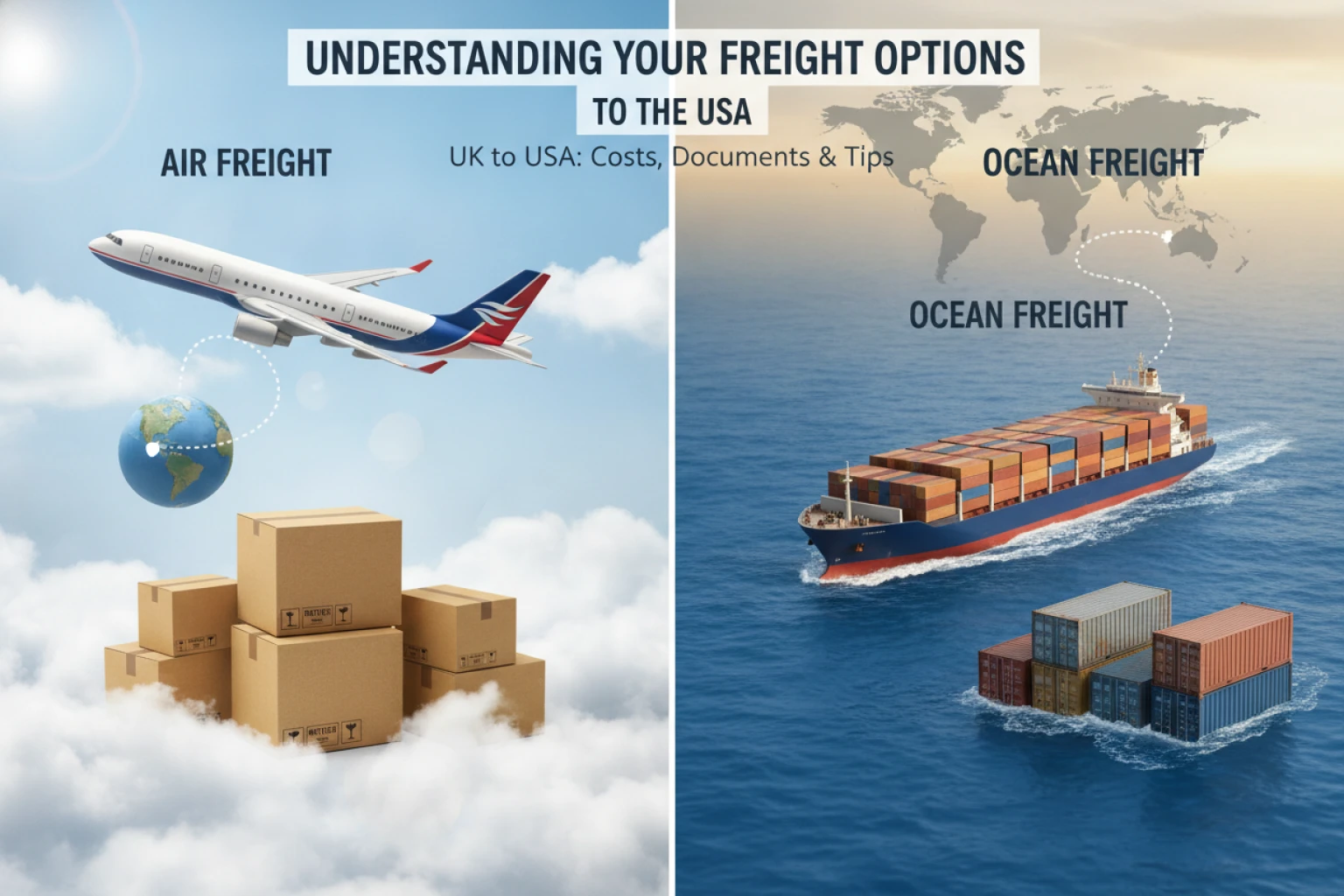
Understanding Your Freight Options: Air Freight vs. Ocean Freight to the USA
Figuring out how to send cargo from UK to USA addresses usually comes down to a classic tug-of-war between your deadline and your cash flow. If you are shipping a few boxed samples, an off-the-shelf courier like DHL works fine. But once your shipment crosses roughly 100 kg or half a cubic metre, standard parcel services become brutally expensive, and booking proper commercial freight forwarders becomes the only sane move.
Your first decision is picking the right mode for your cargo’s profile:
| Freight Mode | Typical Transit (UK to US) | Best Suited For | Billing Basis |
|---|---|---|---|
| Air Freight | 3–7 days | Urgent goods, high-value items, < 2 CBM | Actual weight vs. Volumetric (L×W×H cm ÷ 6,000) |
| Ocean LCL (Shared) | 14–21 days (East) / 25–30 days (West) | Mid-sized loads (1–15 CBM), flexible dates | Per “revenue ton” (1 CBM = 1,000 kg) |
| Ocean FCL (20ft/40ft) | 12–18 days (East) / 22–28 days (West) | Bulk cargo (> 15 CBM), fragile sole-use stock | Flat container rate |
Keep an eye on how carriers calculate chargeable weight. Air forwarders multiply your crate’s dimensions in centimetres and divide by 6,000 (or 5,000 for express couriers). If you pack lightweight apparel into a massive box, you will pay for the empty space it occupies, not what it weighs on a scale.
Ocean freight handles volume differently. With Less-than-Container Load (LCL), you pay per cubic metre (CBM) unless the cargo is unusually heavy (exceeding 1,000 kg per CBM). Just remember: while ocean freight looks dirt cheap at sea, destination port fees, customs clearance, and inland haulage from ports like New York or Los Angeles can shock first-time shippers. If you have under 1.5 CBM and need delivery this week, air cargo frequently wins out once you factor in those fixed seaport handling costs.
Breaking Down the Costs: How Much Does It Cost to Send Cargo from UK to USA?
When budgeting how to send cargo from UK to USA, looking only at base ocean or air freight rates is a rookie mistake. That initial quote is just the tip of the iceberg; mandatory surcharges and port fees often make up half your final invoice.
Carriers tack on standard ocean surcharges right out of the gate. Expect to see the Bunker Adjustment Factor (BAF) for fuel swings, the Currency Adjustment Factor (CAF) to offset pound-to-dollar shifts, and Terminal Handling Charges (THC) at both origin and destination.
Once your shipment hits American waters, US Customs and Border Protection adds its own layer of mandatory fees:
Harbor Maintenance Fee (HMF)
0.125% of the commercial cargo value (ocean freight only).
Merchandise Processing Fee (MPF)
0.3464% of cargo value for formal entries (capped between a statutory minimum of around $31.67 and a maximum of $614.35).
To give you an idea of scale, here is how ocean freight costs typically shape up between Southampton and New York:
| Shipment Profile | Base Ocean Rate | Port & Customs Fees (THC, MPF, HMF) | Estimated Total (Port-to-Port) |
|---|---|---|---|
| LCL (200 kg standard pallet) | $180 – $300 | $150 – $250 | $330 – $550 |
| FCL (20ft dry container) | $1,600 – $2,400 | $600 – $900 | $2,200 – $3,300 |
Note: Rates fluctuate weekly based on seasonal demand, capacity crunches, and fuel adjustments.
Where shippers really get burned, however, is on the final inland leg. If you are delivering to a commercial warehouse with a loading dock, inland trucking is straightforward. But if US Customs flags your container for an intensive X-ray exam, you foot the $300 to $1,000 inspection bill. Need that pallet delivered to a facility without a dock? A liftgate truck surcharge ($75–$150) and a residential delivery fee will appear instantly on your revised bill. Always budget a 15% buffer above your initial freight quote for these landside surprises.

Essential Customs Documents and Regulatory Filings Required by US Authorities
US Customs and Border Protection (CBP) will not accept vague paperwork. If you want to know how to send cargo from UK to USA without expensive port holds, start by treating your commercial invoice and packing list as legal declarations, not mere receipts. Avoid fuzzy terms like “auto parts” or “samples.” Write “machined aluminum brake calipers,” supply the precise 6-to-10-digit HS code, and state the exact unit value and country of origin.
For ocean shipments, your biggest compliance risk is the Importer Security Filing (ISF “10+2”). Your US customs broker must transmit these ten data elements to CBP at least 24 hours before the container ship leaves Felixstowe or Southampton. Miss that cutoff, and CBP routinely slaps the US consignee with a $5,000 fine, followed by an intensive cargo exam at the arrival port.
Every commercial entry also requires an importer identity—usually an IRS EIN for US entities or a CBP-assigned number for foreign importers—paired with a customs bond to secure duties and taxes.
| Bond Type | Best Used For | Typical Cost Structure |
|---|---|---|
| Single Entry Bond (SEB) | 1–2 shipments per calendar year | Calculated per entry value + duty total |
| Continuous Bond | 3+ annual shipments or high-value freight | Flat annual fee covering all US ports |
Keep in mind that CBP also enforces entry rules for other federal bodies (Partner Government Agencies). If your goods fall under these regulated categories, standard customs declarations are not enough:
FDA Prior Notice
Mandatory for food, beverages, supplements, and cosmetics before departure.
USDA / APHIS Permits
Required for untreated timber packaging, plants, and animal products.
EPA & DOT Forms
Forms 3520-1 and HS-7 must accompany any automotive chassis, engines, or road vehicles.
Coordinate these filings with your US buyer’s clearing agent before the freight departs British soil; resolving document omissions while containers sit on a New York pier is a fast route to crippling demurrage fees.

Step-by-Step Guide: How to Package, Label, and Prepare Your Cargo for Safe Transit
Getting your freight safely across the Atlantic comes down to surviving the physical journey. Transatlantic crossings are rough. Container ships battle relentless mid-ocean swells, while cargo holds in aircraft experience sudden turbulence and pressure shifts. If you are figuring out how to send cargo from UK to USA, your packaging needs to withstand forklifts, crane transfers, and days of vibration.
Start with the foundation: the pallet. US Customs and Border Protection will flat-out reject non-compliant wood, stranding your shipment or slapping you with re-export penalties.
| Packaging Component | Standard Specification | Common Mistake to Avoid |
|---|---|---|
| Pallet Base | ISPM-15 heat-treated wood with clear IPPC “wheat” stamp | Using domestic, untreated UK pallets |
| Cartons | Heavy-duty double-wall corrugated (BC-flute) | Reusing old single-wall retail boxes |
| Stabilization | Rigid edge protectors with tensioned poly-strapping | Relying only on thin cling-wrap film |
Stack heavier cartons at the bottom to maintain a low center of gravity. Keep boxes column-stacked—corner to corner—rather than interlocked like bricks. While interlocking feels stable, it cuts carton compression strength by up to 50%. Ensure zero overhang; cartons extending even an inch over the pallet edge lose a third of their load-bearing integrity and invite forklift gouges.
Once stacked, apply vertical corner boards to protect the edges, run at least two tight polyester straps around the load through the pallet base, and wrap the unit in industrial 80-gauge stretch film, tying off directly to the pallet foot.
Finally, fix your documentation to two adjacent sides. Skip handwritten notes. Print smudge-proof shipping marks showing:
Consignee and shipper addresses matching your commercial invoice exactly
Gross weight and net weight in both kilograms and pounds
Legible ISO 780 handling pictograms (such as “Fragile,” “Keep Dry,” or “This Way Up”)
Package tally numbers (e.g., “Box 1 of 6”) to prevent partial clearance delays at US ports

US Customs Compliance, Duty Calculations, and Trusted Regulatory Frameworks
Getting your freight across the Atlantic is only half the battle. If your paperwork stumbles at the port of entry, US Customs and Border Protection (CBP) will happily hold your container while demurrage charges tick up.
To ensure a smooth process when learning how to send cargo from UK to USA, your first stop must always be the US International Trade Commission (USITC) HTS database. Never guess your 10-digit tariff code based on a UK commodity code. Even a slight misclassification—like logging waxed canvas jackets as standard cotton outerwear—can trigger retroactive duties, merchandise processing fees (MPF), or outright audits.
Valuation dictates your clearance route:
Section 321 (De Minimis)
Shipments valued under $800 enter duty-free via informal entry, provided they aren’t consolidated or subject to Partner Government Agencies (like the FDA).
Informal Entry
Covers commercial cargo valued between $801 and $2,500.
Formal Entry
Mandatory for shipments exceeding $2,500. This requires a continuous or single-entry customs bond and a designated US customs broker.
Your commercial invoice must clearly reflect your agreed Incoterms 2020. These rules determine who pays the import duties and where risk shifts:
| Incoterm | Who Pays US Duty & Taxes? | Risk Transfers At… | Best Used For… |
|---|---|---|---|
| DDP (Delivered Duty Paid) | UK Seller | Buyer’s US facility | E-commerce, frictionless buyer experience |
| DAP (Delivered at Place) | US Buyer | Arrival at buyer’s facility | Commercial B2B where the buyer has an import bond |
| FOB (Free on Board) | US Buyer | Vessel’s rail at the UK port | Ocean freight managed entirely by the US importer |
Before booking ocean freight, verify that your UK freight forwarder follows BIFA trading conditions and works with a carrier licensed by the Federal Maritime Commission (FMC). If an unbonded NVOCC handles your sea freight, you have virtually no regulatory recourse if cargo gets stranded at an East Coast terminal.

Common Cargo Shipping Mistakes to Avoid and Choosing the Right Freight Forwarder
Most transatlantic shipping headaches don’t happen in the middle of the Atlantic; they happen on paper days before the vessel even docks. If you want to know how to send cargo from UK to USA without hemorrhaging cash, you have to actively manage US customs triggers.
The fastest way to stall your container is sloppy paperwork. US Customs and Border Protection (CBP) flags vague commercial invoices on sight—listing “machine parts” instead of “steel CNC spindle bearings, HS 8466.93” guarantees an inspection hold. Missing IPPC “bug stamps” on raw wood packaging will get your shipment turned around back to the UK at your expense. For ocean freight, failing to lodge your Importer Security Filing (ISF 10+2) at least 24 hours before loading triggers an automatic $5,000 liquidated damages fine.
To dodge brutal US demurrage and detention fees (often exceeding $250 a day per box), your forwarder must pre-clear entries while the ship is five days out, rather than scrambling at the terminal gate.
Choosing the right partner means vetting credentials, not just comparing rate sheets:
Licensing & Trust
Verify US Federal Maritime Commission (FMC) registration as an NVOCC/freight forwarder, paired with UK AEO (Authorised Economic Operator) status for fast-track clearance.
Transatlantic Volume
Choose a broker with dedicated capacity out of major UK hubs (like Southampton or Felixstowe) into your specific US discharge port.
Milestone Tracking
Demand automated API updates over sporadic email check-ins.
Finally, never trust default carrier liability. If rough weather hits the North Atlantic, the legal baseline leaves you dangerously exposed.
| Coverage Type | Typical Basis | What It Actually Protects |
|---|---|---|
| Carrier Liability (Hague-Visby / Montreal) | Approx. 2 SDR/kg (~$2.60/kg) or $500/package limit | Only proven carrier negligence; excludes acts of God or heavy weather. |
| Institute Cargo Clauses (A) | Full declared commercial value + freight | “All risks” of accidental physical loss or damage door-to-door. |
Buy Clause (A) marine cargo insurance. Relying on baseline carrier liability to replace high-value freight is a gamble you will lose.

FAQS
How do I send cargo from the UK to the USA?
The process comes down to choosing between ocean freight and air freight, then partnering with a reliable forwarder. First, pack your goods on heat-treated, ISPM-15 certified pallets—US Customs will reject non-compliant wood on arrival. Get quotes based on total volume and weight, book your space, and arrange collection from your warehouse or home. Air cargo suits urgent shipments under 300 kg, while sea freight handles larger, heavy stock where transit time isn’t a dealbreaker.
How much does it cost to send cargo from the UK to the USA?
Pricing fluctuates weekly based on fuel surcharges, port congestion, and seasonal demand. Rather than looking only at base freight rates, account for terminal handling charges (THC), US customs clearance fees, and final delivery trucking.
| Shipping Method | Typical Cargo Size | Average Transit | Ballpark Base Cost |
|---|---|---|---|
| Standard Air Freight | 100–300 kg | 3–7 business days | £4.00 – £8.50 per kg |
| Ocean LCL (Shared Container) | 1–10 CBM | 14–24 days | £120 – £220 per CBM |
| Ocean FCL (20ft Container) | Up to 28 CBM | 12–20 days port-to-port | £1,800 – £3,200 total |
Note: Door-to-door moves will cost extra for local inland haulage on both sides of the Atlantic.
What documents do I need to send cargo from the UK to the USA?
US Customs and Border Protection (CBP) is strict. A single missing code can stall your shipment at the port for weeks, racking up demurrage fees.
When you’re sorting out how to send cargo from UK to USA, ensure you have:
Commercial Invoice
Details the buyer, seller, true value, and a precise description of goods (vague terms like “auto parts” or “samples” trigger inspections).
Packing List
Breaks down piece counts, gross and net weights, and dimensions per package.
Bill of Lading (B/L) or Air Waybill (AWB)
Acts as the transport contract and proof of receipt.
10-digit HTS Code
Defines the tariff classification under US trade rules.
ISF (Importer Security Filing / 10+2)
Mandatory for ocean freight. Your US broker must file this at least 24 hours before the vessel departs the UK, or you risk a $5,000 fine.
Conclusion
Figuring out how to send cargo from UK to USA boils down to balancing transit time against your landed cost. Moving commercial freight across the Atlantic is fairly straightforward once you establish a rhythm, but first-time shippers often get tripped up by assumptions about customs and packaging.
The most common pitfall I see is treating transatlantic sea or air freight like standard domestic parcel delivery. If you skimp on pallet prep to save £30, you risk thousands in crushed inventory once ocean containers encounter heavy Atlantic swells. Similarly, missing the 24-hour filing window for the US Importer Security Filing (ISF) on ocean freight triggers automatic $5,000 penalties from US Customs and Border Protection.
To choose your final route, match your product margin and urgency to the right mode:
| Shipping Method | Typical Port-to-Port Time | Best Suited For | Watch Out For |
|---|---|---|---|
| Air Cargo | 2–5 days | High-value, perishable, under 300 kg | Volumetric weight spikes on bulky boxes |
| LCL Ocean | 12–18 days | 1 to 5 standard pallets, flexible dates | Unpacking and destination port fees |
| FCL (20ft/40ft) | 10–14 days | High-volume inventory, fragile cargo | Demurrage charges if customs holds the box |
Before you hand your freight over to a forwarder, run through these final checks:
Lock down the Incoterm in writing
If you sell DAP (Delivered at Place), you pay the freight, but your US customer handles import duties. Never quote DDP unless your US customs broker is already lined up.
Confirm the HTS codes
Do not let your carrier guess your tariff classification. A minor mismatch can trigger physical border inspections and weeks of warehouse storage fees.
Use heat-treated wood
Any timber pallets or crates must carry the ISPM-15 stamp, or US customs will reject the entire consignment at the dock.
Get the paperwork right on day one, pack for rough transit, and transatlantic freight runs like clockwork.