
How Sea Cargo from the UK to Pakistan Works: Step-by-Step
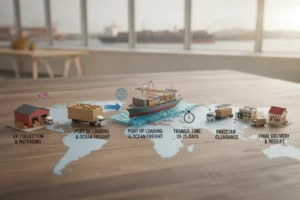
Moving freight across continents sounds intimidating, but the actual journey follows a well-trodden route. If you are sending personal effects, excess baggage, or commercial inventory, booking sea cargo from the UK to Pakistan comes down to four distinct stages: collection, export paperwork, the deep-sea transit, and local clearance.
Here is what happens behind the scenes once your cargo leaves your hands.
1. Collection and Container Packing
Most shippers arrange a nationwide doorstep collection, whether you are in Manchester, London, or Glasgow. Once at the depot, your forwarder determines how your cargo travels:
| Option | Best For | How It Works |
|---|---|---|
| LCL (Less than Container Load) | Boxes, pallets, small loads under 10–12 CBM | Consolidated into a shared container with other shipments. |
| FCL (Full Container Load) | Whole-house moves, heavy machinery, bulk cargo | You hire the exclusive use of a 20ft or 40ft steel box. |
Quick tip: If you choose LCL, pack thoroughly. Shared boxes get shifted during consolidation, so flimsy retail cartons often split before they even reach the port.
2. Export Declarations and Ocean Voyage
Before the container loads at Southampton, Felixstowe, or London Gateway, your forwarder submits an export declaration through the UK customs system (CDS). You will need a detailed packing list and valued invoice—vague descriptions like “miscellaneous household items” will trigger physical holds.
From the UK, container vessels steam south through the Mediterranean, transit the Suez Canal, and enter the Arabian Sea. Expect the water transit alone to take roughly 20 to 30 days, barring canal congestion or bad weather.
3. Arrival, Clearance, and Last-Mile Haul
Vessels dock at either Karachi Port (KPT) or Port Muhammad Bin Qasim. Here, Pakistani customs examine the cargo, assess Goods Declarations (GD), and collect duties. Once cleared, containers travel upcountry by bonded carrier or local truck to inland dry ports and doorsteps across Lahore, Islamabad, Faisalabad, and beyond.
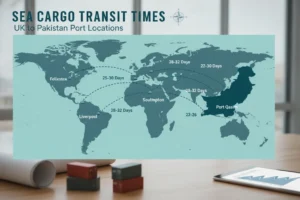
Sea Cargo Transit Times from the UK to Pakistan Port Locations
If you are planning sea cargo from the UK to Pakistan, expect a baseline water transit of 25 to 35 days. This covers the vessel’s journey from major British container hubs like Felixstowe or Southampton to the Port of Karachi (either KICT or QICT).
However, your cargo rarely moves port-to-port in isolation. The actual door-to-door timeline depends heavily on how your shipment is packed and where it finishes its journey.
FCL vs. LCL: The Packing Buffer
Full Container Loads (FCL) move on the fastest timeline because the box is sealed at your premises and loaded straight onto the vessel. If you use Less than Container Load (LCL) consolidation—sharing container space for a few boxes or pallets—you need to build in an extra 7 to 14 days. Freight forwarders require time at UK depots to consolidate multiple consignments, and customs brokers in Karachi need several days to destuff and sort the container before individual clearance can even begin.
| Shipment Type | Typical Ocean Leg | Origin/Destination Handling | Total Port-to-Port Window |
|---|---|---|---|
| FCL (Full Container) | 25 – 35 days | 3 – 5 days | 28 – 40 days |
| LCL (Consolidated) | 25 – 35 days | 10 – 14 days | 38 – 50 days |
Reaching Upcountry Dry Ports
Karachi is just the entry gate. If your final delivery is destined for inland industrial hubs—like Lahore, Faisalabad, or Sialkot—factor in an additional 3 to 7 days. Your goods must clear initial maritime checks, transfer to Pakistan Railways or a bonded road carrier, and travel under customs seal to an upcountry dry port before final duty payment.
Real-World Disruption Risks
Schedules on paper often slip. When quoting delivery dates to clients or family, keep three major bottlenecks in mind:
- Choke point diversions: Modern geopolitical shifts—such as routing vessels around Africa’s Cape of Good Hope rather than the Suez Canal—instantly add 10 to 14 days to standard sailing rotations.
- Pre-holiday backlogs: Ocean freight volumes spike dramatically in the four to six weeks leading up to Ramadan and Eid. Berthing delays at Karachi ports during these peak windows are routine.
- Monsoon weather: Heavy Arabian Sea squalls between June and August frequently slow down crane operations and container discharge rates along the coast.
Permitted and Restricted Items: What You Can Send via Ocean Freight
Booking container space sounds simple until customs officials at Karachi Port flag a box because of an unlabelled bottle of perfume or a loose power tool battery. Sorting your cargo correctly before loading saves weeks of demurrage charges and paperwork headaches.
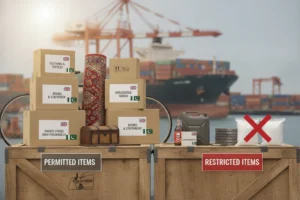
Most non-commercial bookings revolve around household relocations or sending goods back home to family. Used personal effects generally sail through clearance without friction, provided you pack them sensibly.
Clothing and linen:
Second-hand clothes and household textiles must be clean and dry. Avoid packing damp fabrics, as weeks inside a steel container crossing tropical waters will cause mould.
Appliances and flat-packs:
Microwaves, blenders, and flat-pack furniture travel well in ocean freight. Always drain standing water from washing machines and disassemble bulky furniture to prevent transit torque from cracking the joints.
If you are moving commercial cargo, documentation matters as much as the physical goods. Shipping industrial machinery parts, rolls of fabric, or raw plastics requires an accurate packing list matched against an active Pakistani National Tax Number (NTN). Commercial electronics require declared serial numbers and, where applicable, compliance certificates to clear Pakistan Customs under formal WeBOC declarations.
The real trouble usually stems from hazardous materials regulated by the International Maritime Dangerous Goods (IMDG) Code, as well as national bans under Pakistan’s Import Policy Order.
| Cargo Classification | Common Examples | Status / Action Needed |
|---|---|---|
| Dangerous Goods (IMDG) | Lithium-ion batteries, aerosols, paints, solvent glues | Restricted. Requires hazardous goods declarations, MSDS sheets, and special carrier approval. Never sneak loose power banks into boxes. |
| Culturally / Legally Banned | Alcohol, narcotics, pork products, anti-state or blasphemous prints | Strictly prohibited. Total confiscation, heavy fines, and potential criminal prosecution under the Import Policy Order. |
| Financial / Security Risks | Counterfeit cash, unregistered communication radios, replica weapons | Strictly prohibited. Seized immediately by port authorities. |
When preparing sea cargo from the UK to Pakistan, the safest rule of thumb is separation: never mix borderline chemicals or electronics with standard household boxes, and declare every single motor or battery upfront.
Understanding Pricing Models: LCL vs FCL Sea Freight Explained
When booking sea cargo from the UK to Pakistan, your total bill boils down to a simple operational choice: are you renting space on a shared pallet, or are you buying out the entire steel box?
For smaller shipments—think four or five standard tea-chest boxes of clothes or a couple of suitcases—freight handlers use Less than Container Load (LCL). You pay strictly for the volume you occupy, measured in cubic metres (CBM). In practice, forwarders usually round up to the nearest whole CBM or charge a minimum flat fee for the first cubic metre, regardless of whether your goods fill it.

Once your volume crosses roughly 13 to 15 CBM, the math flips. Packing half a dozen oversized wooden crates into shared space often costs more than hiring an entire container through Full Container Load (FCL).
| Metric | LCL (Shared Container) | 20ft FCL (Dedicated) | 40ft FCL (Dedicated) |
|---|---|---|---|
| Usable Volume | 1 to 12 CBM (typical) | ~33 CBM | ~67 CBM |
| Best For | Cartons, excess baggage, small gifts | 1–2 bedroom house move | 3–4 bedroom villa relocation |
| Pricing Unit | Per CBM / per box | Flat rate per container | Flat rate per container |
A quote that looks cheap on paper rarely covers the entire journey. Beyond the baseline ocean freight, a standard invoice includes:
UK origin fees:
Collection from your doorstep, export packing, and terminal handling charges (THC) at ports like Southampton or Felixstowe.
Paperwork charges:
Bill of Lading issuance and export customs declarations.
The real budget-busters happen after arrival. Shippers often get blindsided at Port Qasim or Karachi Port by destination terminal charges, customs examination labor fees, and container demurrage.
If your consignee faces paperwork snags or Pakistani customs flags your cargo for physical inspection, free port storage evaporates within days. After that window closes, terminal authorities charge daily penalty rates that can eclipse the original shipping fee before the container even clears the gate.
Real-World Shipping Scenarios: From Baggage Relocation to Bulk Cargo
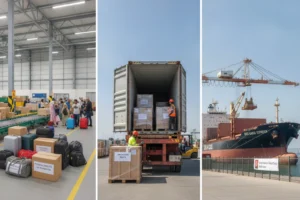
Every shipment looks clean on an invoice, but the water transit between Britain and the Arabian Sea tests how well you planned. Here is how booking sea cargo from the UK to Pakistan plays out across three typical loads.
1. Birmingham to Islamabad: The Full Household Move
A family relocating from the West Midlands packed a three-bedroom house into an exclusive 20ft container (FCL).
The crew spent two days wrapping furniture in export-grade corrugated cardboard, securing goods onto pallets, and building a strict packing inventory. The container was hauled down to Southampton, sailed to Port Qasim, and transferred via bonded rail to the Islamabad Dry Port. Total transit hit 42 days door-to-door, largely because avoiding shared container space eliminated customs hold-ups caused by other shippers.
2. London to Karachi: The Budget Box Run
A student returning to Sindh sent three oversized boxes containing winter clothes, kitchenware, and family gifts.
Paying for a dedicated container makes zero sense here. Instead, an LCL (Less than Container Load) service worked best: the forwarder collected the boxes in East London, consolidated them into a shared bin at the depot, and shipped them via Karachi Port. The trade-off was speed—it took seven weeks, but cost a fraction of air freight.
3. Manchester to Lahore: Industrial Spares
A Manchester equipment distributor shipped replacement weaving loom parts directly to a manufacturing plant in Lahore. They used multi-modal sea freight: ocean shipping to Karachi, clearing transit customs, then moving inland by flatbed truck.
| Shipment Profile | Route | Transit Mode | Port of Entry | Door-to-Door Time |
|---|---|---|---|---|
| Household Relocation | Birmingham → Islamabad | 20ft FCL (Sole-use) | Port Qasim (Rail to dry port) | ~6 weeks |
| Excess Personal Baggage | London → Karachi | LCL (Consolidated boxes) | Karachi Port | ~7–8 weeks |
| Machinery Components | Manchester → Lahore | Multi-modal Sea + Road | Karachi to Lahore Dry Port | ~5–6 weeks |
Lessons from the Water
The Arabian Sea route exposes cargo to extreme humidity swings inside steel boxes. A few non-negotiables we tell clients to stick to:
- Build bespoke wooden crates for electronics or fragile goods; standard double-wall cardboard often crushes when stacked three pallets high.
- Wrap everything in heavy-duty shrink film to keep out salt air, and toss industrial silica gel packs inside sealed plastic linings to stop mildew before it starts.
Customs Clearance and Import Duty Rules Backed by Pakistan Customs Regulations
Getting your shipment through Port Qasim or Karachi Port comes down to how well your paperwork matches what is physically inside the container. When moving sea cargo from the UK to Pakistan, your shipment falls directly under the Federal Board of Revenue (FBR) tariff schedules.
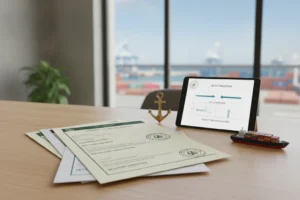
The FBR does not simply take your receipt at face value. Customs appraisers evaluate your cargo against their own valuation rulings. You are assessed not just for standard customs duty, but also regulatory duty (RD), additional customs duty (ACD), and sales tax—often pushing taxes far higher than people expect if items are flagged as luxury or commercial-grade.
Everything moves through WeBOC (Web-Based One Customs), Pakistan’s mandatory digital filing platform. Whether you are an individual clearing personal belongings or a business handling a full container load (FCL), you must file a Goods Declaration (GD) in WeBOC. If you don’t have an active WeBOC profile, you will have to authorize a licensed clearing agent via their platform to file on your behalf using your CNIC or NTN.
Navigating the Duty Routes: TR vs. Baggage Rules
Overseas Pakistanis moving back permanently should consider applying under the Transfer of Residence (TR) scheme rather than standard baggage rules:
| Route | Minimum UK Stay | Key Benefit | Catch |
|---|---|---|---|
| Transfer of Residence (TR) | 2 continuous years | Substantial duty exemptions on used household goods | Strict limits on electronics; cannot claim again for several years |
| Gift / Baggage Scheme | 180 to 700 days | Basic used personal effects enter duty-free | High regulatory duties hit boxed new items and appliances |
The Clearance Pack That Prevents Red-Lane Holds
Customs officers triage shipments into green, yellow, or red channels. Vague packing descriptions—like writing “miscellaneous household goods” on a box packed with consumer electronics—instantly send your container to the physical examination (red) yard, racking up terminal demurrage by the day.
Ensure your agent submits:
- The Original Ocean Bill of Lading (BL): Must name the actual recipient, matching their Pakistani identity card exactly.
- Itemized Packing List and Values: Quantities, makes, and models clearly stated, differentiating used goods from brand-new items.
- CNIC or NICOP Copy: Attested copy of the consignee’s national identity card.
- Passport with UK Exit Stamp: Crucial if you are claiming TR relief, proving you have ended your residency in the UK.
Choosing a Reliable Freight Forwarder and Preparing Your Consignment
Booking sea cargo from the UK to Pakistan isn’t just about finding the cheapest rate per cubic metre. If your forwarder cuts corners in the UK, your shipment will likely face delays, hidden port charges, or customs disputes once it docks at Port Qasim or Karachi Port.

Start by vetting their credentials. Look for BIFA (British International Freight Association) membership, which binds the forwarder to standard trading conditions and professional liability standards. Just as critical is their presence on the ground in Pakistan: do they hand your paperwork to an unknown third party, or do they work with an established clearance agent in Karachi who actually answers the phone when customs requests an inspection?
Preparing Cargo for the Ocean Voyage
Container ships endure heavy swells, engine vibration, and extreme humidity shifts over a 6,000-nautical-mile journey. Single-wall supermarket boxes simply crush under these conditions.
- Box choice: Pack exclusively with double-walled heavy-duty corrugated cartons.
- Moisture control: Ocean containers sweat. Line boxes with polythene sheeting and toss in silica gel packs for electronics, textiles, and paperwork.
- Immobilisation: Palletise whenever possible using heat-treated (ISPM-15 compliant) wooden pallets, then wrap tightly with industrial stretch film and polypropylene strapping.
Selecting the Right Marine Insurance
Standard forwarder liability usually pays out pennies per kilo, which won’t help if water damages an engine part or electronics. You need dedicated marine cargo cover:
| Insurance Type | What It Covers | Best Used For |
|---|---|---|
| Total Loss Only (TLO) | Major catastrophic loss (vessel sinks, container lost overboard, total fire). | Low-value, non-fragile personal effects or scrap machinery. |
| All-Risks Marine Policy | Theft, rough handling, water damage, and partial losses. | Commercial stock, high-value electronics, and new household goods. |
The Pre-Loading Sign-Off
Before handing over your consignment, confirm who pays the destination charges. A rock-bottom freight quote often hides astronomical local clearing and demurrage fees in Karachi. Always demand an itemised quotation that clearly defines delivery terms (such as CFR vs DDP), provides vessel tracking details, and states clearing agent fees in writing before the container doors close.
You can also track your parcel from our track your parcel page or contact us on whatsapp.