
How Much Does Cargo from the UK to Pakistan Cost per Kg in 2027?
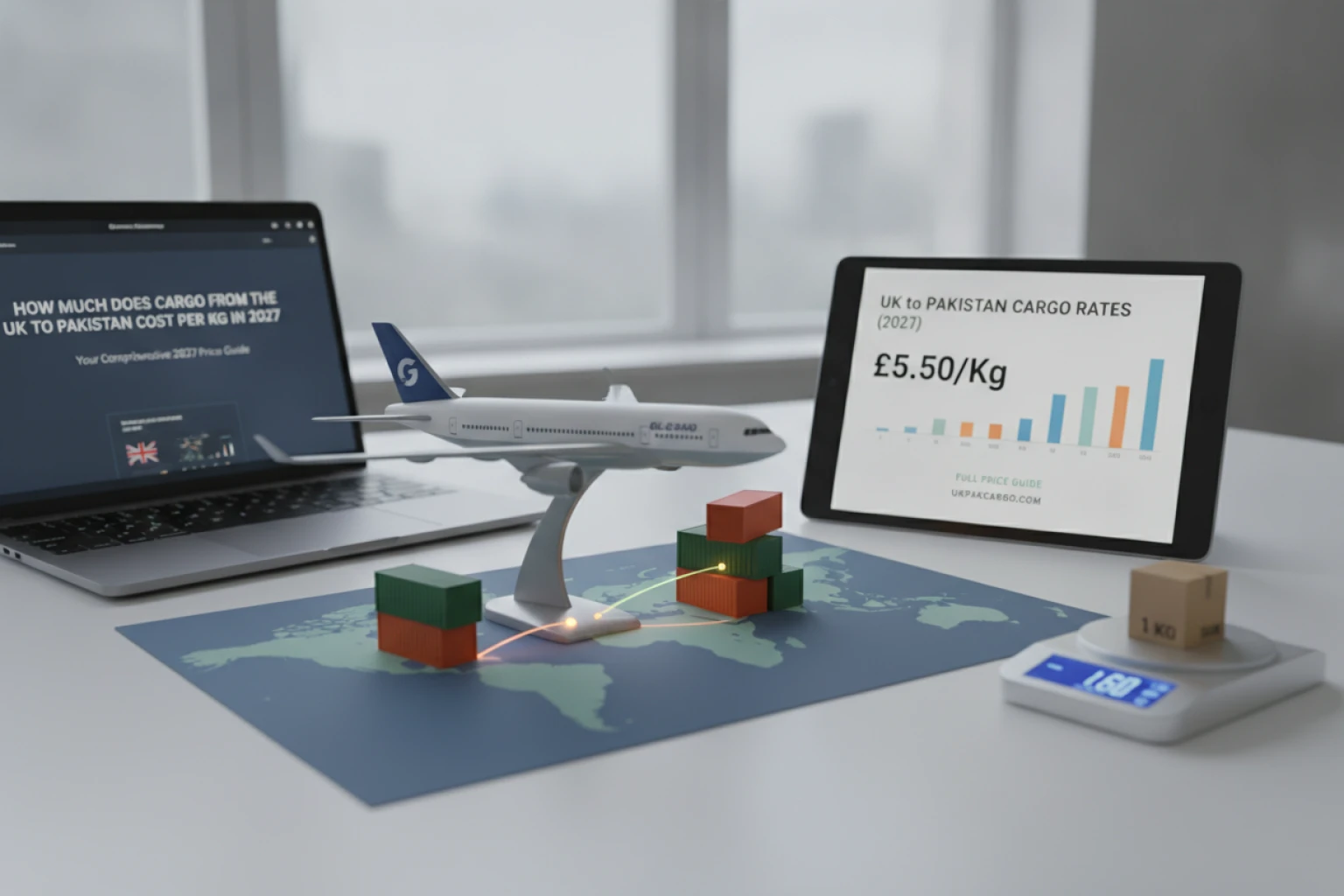
Planning to send a parcel back home to family in Lahore, or shipping commercial stock to a warehouse in Karachi? Figuring out the true cost can feel like chasing a moving target. In 2027, standard UK to Pakistan cargo rates per kg generally fall between £1.20 and £2.00 for sea freight, while standard air freight runs from £4.50 to £8.00 per kg.
Here is how the base numbers stack up today:
| Transit Method | Typical Rate (per kg) | Minimum Weight Rule | Best Suited For |
|---|---|---|---|
| Sea Cargo | £1.20 – £2.00 | 20–30 kg | Bulky household moves, non-urgent heavy cartons |
| Air Cargo | £4.50 – £8.00 | 5–10 kg | Gifts, urgent documents, electronics, tight deadlines |
The headline rate on a leaflet is rarely what you pay at checkout. Most freight forwarders enforce strict weight floors. Drop off a modest 8 kg parcel for sea transit, and you will not pay £12; the company will bill you a flat minimum baseline fee matching their 25 kg threshold. If you have a small, heavy parcel, air shipping often ends up cheaper overall than triggering a sea depot’s minimum charge.
Your final invoice also reflects backend logistics:
Route setup
Airport-to-airport bookings look cheap upfront, but you leave clearance duties and local collection to your recipient. Door-to-door covers the messy customs legwork and direct delivery right to the address in Pakistan.
Surcharges
Aviation fuel levies update monthly, and clearing UK export documentation requires strict post-Brexit paperwork before goods clear Heathrow or Manchester.
Destination bottlenecks
Offloading through Port Qasim or Karachi Port comes with terminal handling fees that many budget consolidators hide until the container berths.
Below, we break down these extra line items so you can calculate your exact shipping budget with zero surprises.
Air Cargo vs. Sea Cargo: Which Shipping Method Fits Your Budget and Timeline?
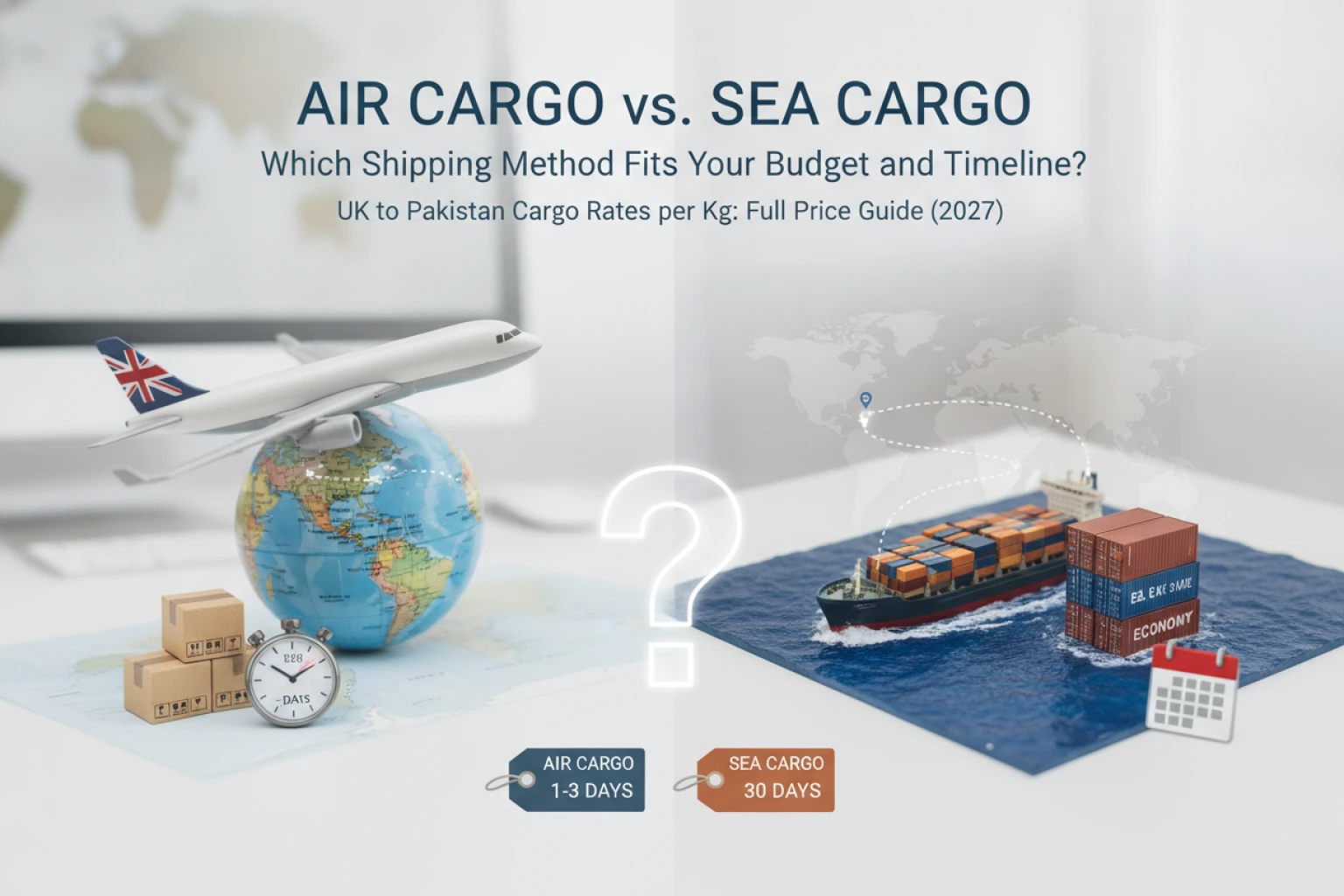
Choosing between air and ocean freight comes down to a direct trade-off: speed versus volume. While air transit lands your boxes in Lahore, Karachi, or Islamabad within 5 to 8 working days, containerised vessels leaving British hubs like Southampton or Felixstowe usually take 6 to 8 weeks to dock.
Air freight looks attractive until you run into the “volumetric weight” trap. Airlines charge you for whichever is higher: the actual scale weight or the space your parcel takes up. Using the industry-standard formula:
$$\frac{\text{Length (cm)} \times \text{Width (cm)} \times \text{Height (cm)}}{5000} = \text{Volumetric Weight (kg)}$$
A 6 kg carton packed with lightweight winter quilts might measure $60 \times 50 \times 40\text{ cm}$. That calculates to 24 kg of dimensional weight. The airline will bill you for 24 kg, instantly wiping out your budget.
| Factor | Air Cargo | Sea Cargo |
|---|---|---|
| Typical Transit | 5–8 working days | 6–8 weeks |
| Pricing Basis | Greater of actual or volumetric weight | Volume ($m^3$) or deadweight tonnage |
| Best For | Electronics, urgent gifts, sensitive paperwork | Heavy furniture, whole-house moves, heavy machinery |
| Bottleneck Risk | Flight cancellations, regional airport customs | Port Qasim berth congestion, customs holdups |
If you are shipping heavy, dense items—think dining tables, washing machines, or full household clearances—sea freight is far more forgiving. However, the sea route demands patience. Containers often encounter customs backlogs at Port Qasim, and if your shipment arrives right around Ramadan or Eid, expect dockside operations to slow down significantly.
To keep your UK to Pakistan cargo rates per kg sensible, reserve air cargo strictly for compact, high-value, or time-critical goods. For everything else, pack early, book a sea container, and plan around seasonal port slowdowns.
Detailed Breakdown of Hidden Charges, Customs Duties, and Port Fees
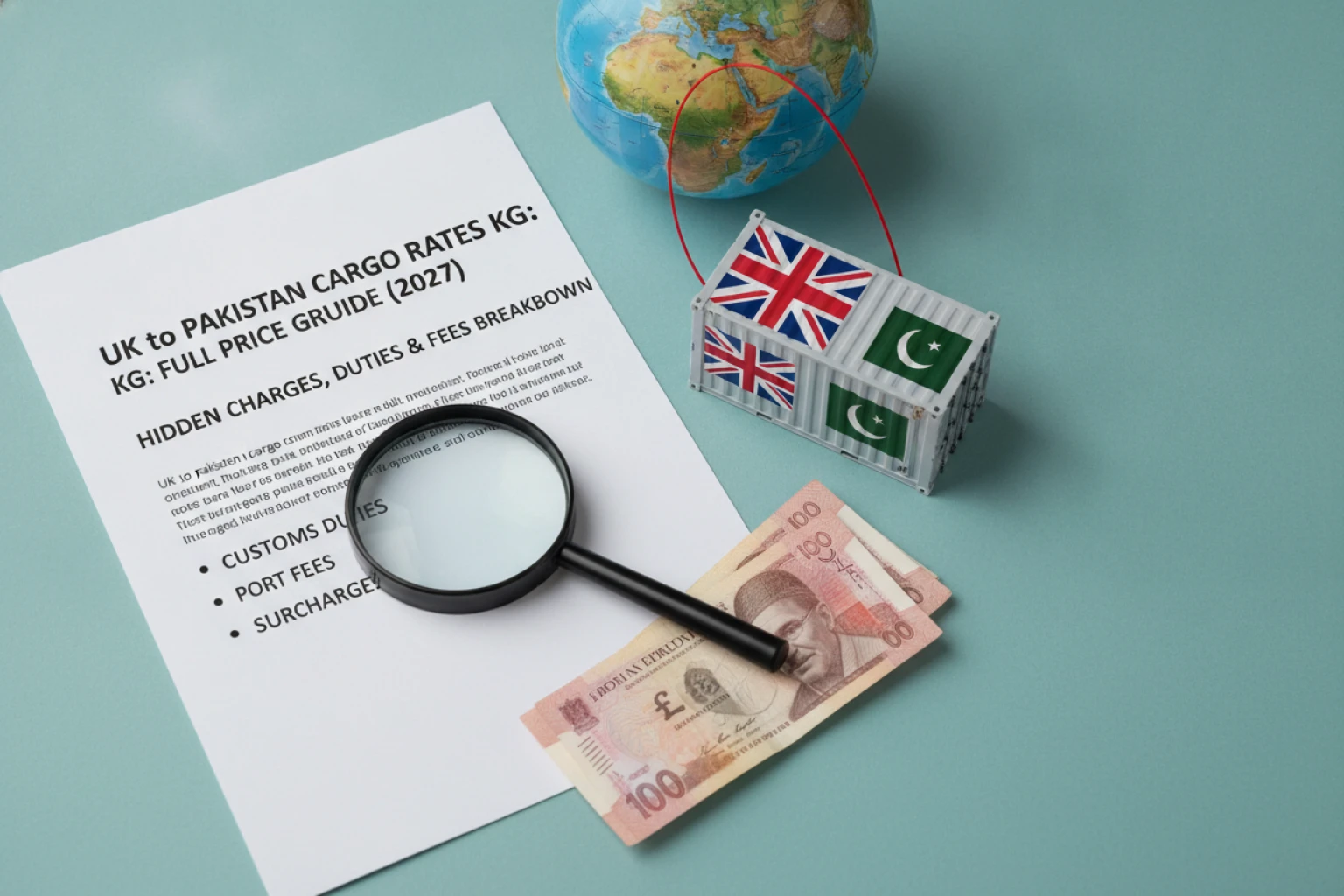
That £1.80 per kg quote looks great on paper—until your shipment reaches Port Qasim or Islamabad Airport. Many shippers confuse freight transit prices with landing costs, forgetting that the Federal Board of Revenue (FBR) treats commercial imports and personal effects very differently.
Overseas Pakistanis returning home do get duty exemptions under the FBR’s Baggage Rules for used personal items. However, send brand-new goods with tags or in commercial quantities, and standard customs tariffs kick in immediately.
Some categories carry steep tariffs regardless of who sends them:
| Item Category | FBR Assessment Basis | Extra Regulatory Costs |
|---|---|---|
| Smartphones | Based on C&F device value | Heavy PTA registration tax (DIRBS) |
| Laptops / PCs | Assessed on age & specs | Regulatory duty (often waived if single used unit) |
| New Home Appliances | Invoice value or FBR valuation list | Standard customs duty + sales tax (approx. 35–50%) |
Phones are the classic trap. A high-end handset sent from London might only cost £15 in air freight, but the recipient must clear the Pakistan Telecommunication Authority (PTA) tax before it connects to local networks. That fee can easily exceed the device’s resale value.
Beyond customs, port-side surcharges add up fast if paperwork stalls:
Terminal Handling Charges (THC)
Charged by the port or airport for offloading and moving cargo containers.
Demurrage fees
Port storage penalties that kick in within days if customs clearance hits a snag.
Documentation processing fees
Courier agent administration fees for filing clearing bills (WeBOC).
Finally, be wary of “all-inclusive door-to-door” promises. While standard UK to Pakistan cargo rates per kg usually cover delivery to central hubs like Lahore, Karachi, or Rawalpindi, they routinely exclude extended area surcharges. If your family lives out in rural Azad Kashmir, interior Sindh, or distant parts of Khyber Pakhtunkhwa, local couriers will tack on a separate last-mile delivery fee before handing over the boxes. Ask your forwarder upfront whether your destination postal code triggers an out-of-area surcharge.
Real-World Cost Scenarios: What You Will Actually Pay for Common Shipments
A headline rate on a leaflet rarely matches your final invoice. If an agent quotes you £2.50 per kilo, you might still walk away paying double once collection surcharges, customs clearance, and local handling get tacked on.
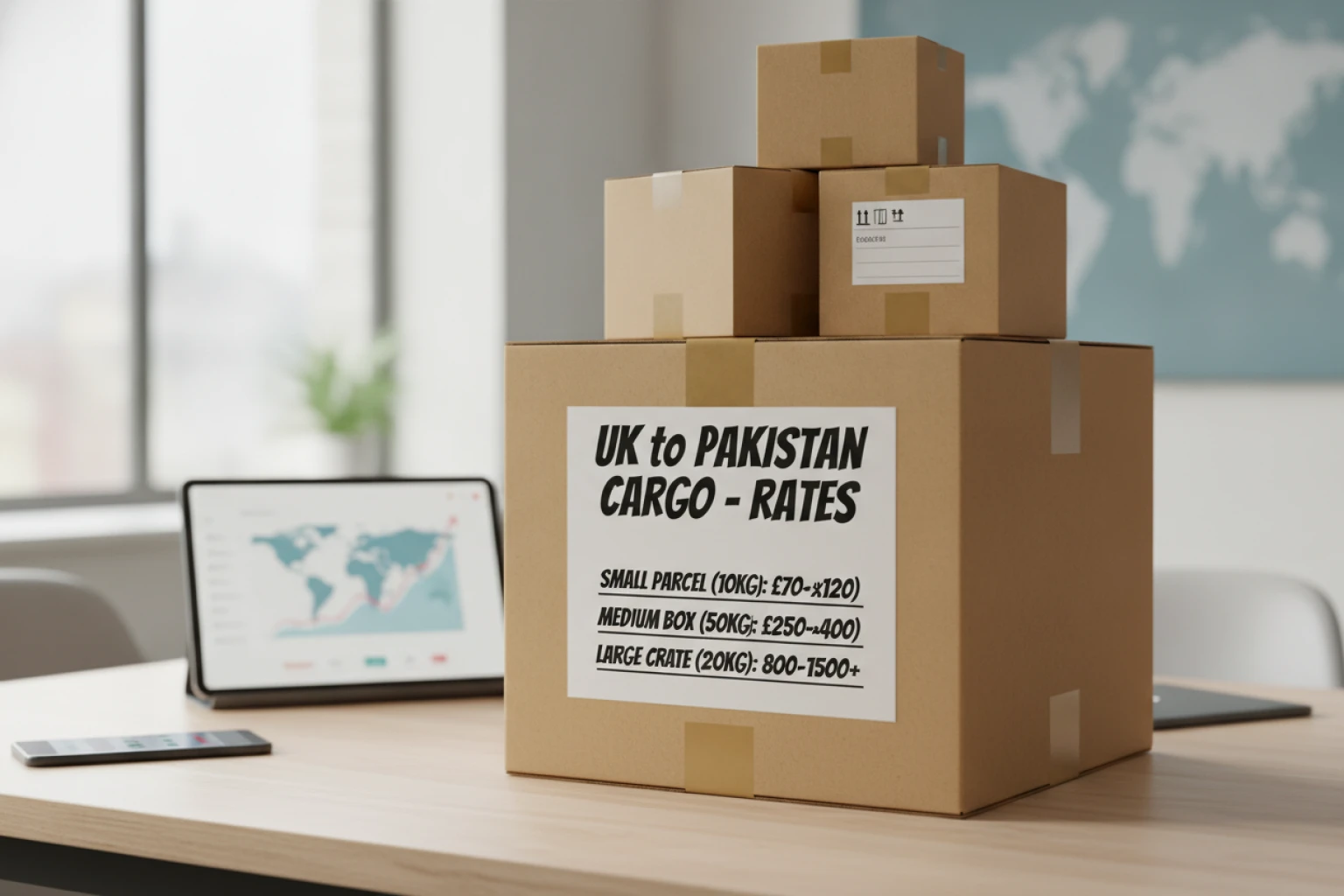
To help you budget accurately, here is how the numbers play out across three everyday routes.
Scenario A: The 20 kg Family Care Package (London to Lahore)
You are sending clothes, branded toiletries, and non-perishable treats to family. Standard airport-to-door air freight handles this best. At this weight bracket, UK to Pakistan cargo rates per kg hover around £4.50 to £6.00 for air cargo.
- Gotcha: Toiletries often trigger small-batch dangerous goods screening if they contain aerosols or perfumes. Stick to dry goods to keep the bill flat.
Scenario B: Partial Home Move of 150 kg (Birmingham to Faisalabad)
If you are clearing out furniture, bedding, and kitchenware, air freight will obliterate your budget. Sea cargo (LCL, or less-than-container load) is the sensible path. The base freight looks dirt cheap, but inland transport in Pakistan—moving goods upcountry from Port Qasim to Faisalabad—drives up the bill. Always insist on an all-inclusive, door-to-door quote so you aren’t surprised by port detention fees.
Scenario C: Urgent 5 kg Textile Samples (Manchester to Karachi)
When an export business needs woven fabric swatches cleared within 72 hours, standard cargo consolidators are too slow. You need an express air courier. Here, minimum airway bill fees apply, meaning you pay a premium flat charge regardless of how tiny the box is.
The Real Invoices: Quoted Base Rate vs. Landed Cost
| Shipment Detail | Quoted Base Rate | Add-Ons (Fuel, Handling, Clearance) | Actual Landed Cost |
|---|---|---|---|
| 20 kg Gifts (Air, LHR to LHE) | £90 (£4.50/kg) | £35 (Collection + local door delivery) | £125 |
| 150 kg Move (Sea, BHX to LYP) | £195 (£1.30/kg) | £160 (Customs seal, inland transit, terminal handling) | £355 |
| 5 kg Samples (Express, MAN to KHI) | £70 (£14.00/kg) | £25 (Duty pre-payment & fuel surcharge) | £95 |
Before handing over your boxes, ask your forwarder one blunt question: “Does this price include clearance on the Pakistan side, or will the consignee have to pay duties at the depot?” That single detail makes or breaks your budget.
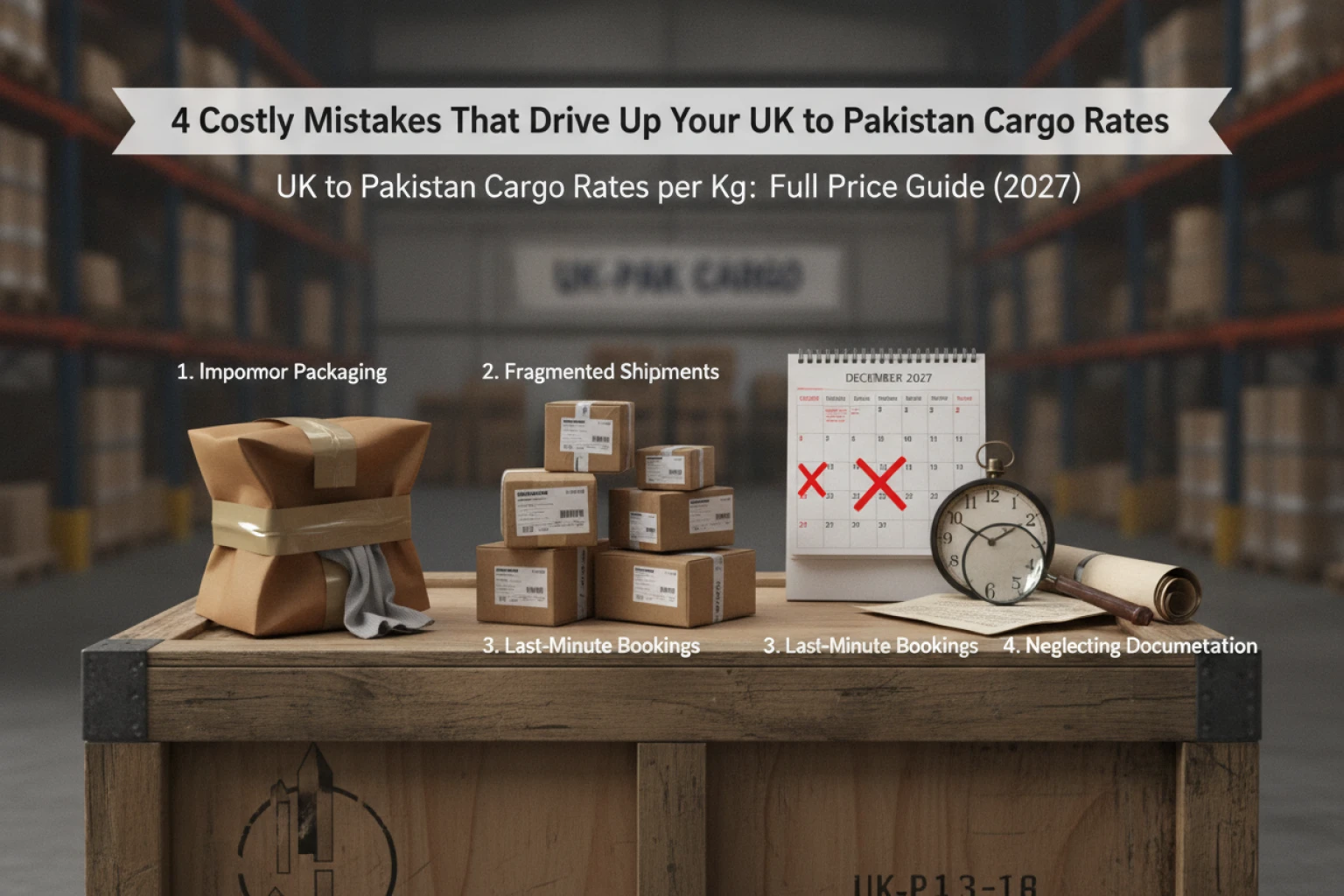
4 Costly Mistakes That Drive Up Your UK to Pakistan Cargo Rates
Most people assume the quote they get upfront is the final price they’ll pay. Then the depot invoice lands, or worse, customs holds the parcel in Karachi, and the bill doubles. Avoiding these budget traps comes down to understanding how cargo handlers and customs officers actually assess your freight.
1. Using Soft, Flimsy Boxes
Supermarket crisps boxes or single-wall cartons bow out under pressure. When your box bulges at the sides, depot laser scanners measure the widest points. Suddenly, your 15 kg parcel is billed as 23 kg volumetric weight. Even worse, if the depot deems your packaging unstable for pallet stacking, they will charge you a mandatory repackaging fee—often £15 to £30 per box—before it ever moves.
2. “Downplaying” Values on the Declaration
Under-declaring high-value items to sidestep duties rarely works. Pakistan’s Federal Board of Revenue (FBR) uses valuation valuation books for electronics, new clothing, and household appliances. If an inspector opens a carton marked “used clothes” and finds brand-new iPhones or branded cosmetics, they will impound the entire consignment. You won’t just pay the original tariff; you’ll face severe misdeclaration penalties and demurrage fees while the freight sits in port limbo.
| Packaging Choice | Risk Factor | Likely Cost Consequence |
|---|---|---|
| Single-wall recycled box | Sides bulge; depot rejection | Dimensional weight surge + £20 repack fee |
| Double-wall heavy duty box | Holds strict cubic dimensions | Billed strictly by actual deadweight |
3. Hiring “Brokers” Instead of Real Forwarders
Many high-street cargo shops in Birmingham or Bradford don’t own their supply chain. They take your cash and hand the freight off to unvetted third parties. If their clearance agent in Pakistan lacks proper customs licensing, your shipment gets stuck in clearing bottlenecks where storage charges rack up daily. Always ask: Do you have your own dedicated clearance staff at the port of entry?
4. Booking Directly Inside Peak Surge Windows
Shipping two weeks before Ramadan, Eid-ul-Fitr, or Christmas guarantees inflated invoices. Air cargo holds fill up fast, belly space gets auction-priced, and standard UK to Pakistan cargo rates per kg spike sharply to offset airline congestion fees.
To keep your costs predictable:
Ship sea freight 8–10 weeks before major holidays
not a month prior.
Book air freight at least 3 weeks ahead
of the festive rush.
Buy proper double-walled export boxes
directly from packaging suppliers, not corner shops.
How to Choose a Reliable Cargo Forwarder: Regulatory Checks and Next Steps
Cheap shipping turns expensive fast if your boxes go missing in transit or get tied up by customs officials in Karachi. Finding the right forwarder isn’t just about shaving pennies off your quote; it comes down to making sure a company has the legal standing to protect your goods.
Start by vetting their paperwork before you hand over any parcels. A legitimate UK forwarder should operate as a registered trading member of the British International Freight Association (BIFA) or hold FIATA credentials. Always cross-check their trading name on UK Companies House to confirm they run an active business, not a shell company operating out of a residential garage.
Before booking, put their policies under the microscope:
| Check | What to Look For | Red Flag |
|---|---|---|
| Transit Insurance | Marine/cargo cover per kilogram policy terms | “Goods carried at owner’s risk” with zero liability |
| Tracking Quality | Real-time container updates via dry port check-ins | Vague WhatsApp messages saying “it’s on the ship” |
| Pricing Model | Fixed per-kg rate including fuel surcharges | Low headline rate that balloons with hidden port fees |
Ask directly about their tracking transparency. Your forwarder should provide tracking checkpoints that log your shipment as it leaves the UK collection hub, boards the vessel, and lands at major inland destinations like the Lahore Dry Port (Mughalpura) or Islamabad Dry Port. If their tracking system goes dark the moment a container hits the Arabian Sea, walk away.
Finally, protect your wallet with a clear pre-booking routine. Insist on a written, itemised invoice that fixes your UK to Pakistan cargo rates per kg alongside any local handling fees. Never schedule a van collection based on a verbal phone estimate. Once you have a signed quote guaranteeing your rate and confirming clearance responsibilities, you can book your pickup with complete peace of mind.
UK to Pakistan Cargo: A Complete Guide to Rates per Kg
Pricing your shipment shouldn’t feel like guesswork, but cargo quotes often come with surprises once the tape leaves the box. Right now, standard UK to Pakistan cargo rates per kg generally sit between £1.50 and £4.50, depending on speed, destination, and transport mode.
Sea freight is your best bet for heavy household items or wedding dowries where time isn’t an issue. Air cargo costs more upfront, but it skips the weeks spent waiting at Karachi port.
Here is how the numbers stack up in practice:
| Service Type | Typical Transit Time | Avg. Cost / Kg | Best For |
|---|---|---|---|
| Sea Cargo | 6–8 Weeks | £1.50 – £2.20 | Heavy boxes (30kg+), furniture, clothes |
| Standard Air | 7–10 Days | £3.80 – £4.80 | Gifts, non-perishable food, moderate parcels |
| Express Air | 3–5 Days | £6.50 – £9.00 | Urgent documents, commercial samples |
The biggest trap shippers fall into is ignoring volumetric weight. If you pack 10kg of lightweight winter blankets into a massive suitcase, carriers charge you for the space it steals in the hold, not the number on your bathroom scale.
Before booking, keep three practical rules in mind:
Watch the minimum charge
Most sea cargo handlers set a baseline fee (often 20kg or 30kg). Sending a single 8kg parcel by sea ends up costing far more per kilo than simply using air.
Know the delivery zone
A drop-off in central Lahore or Islamabad is straightforward. Deliveries to remote villages in Azad Kashmir or rural Sindh usually incur an extra “out-of-area” surcharge.
Avoid mixed-category packing
Tucking branded electronics into a carton of used clothing will immediately flag your box at customs, triggering inspection delays and sudden duty bills.
If your shipment isn’t urgent, wait until you have gathered at least 40kg to 50kg. Consolidating into one collection run cuts the base handling fees and locks in the cheapest per-kilo rate.
FAQS
How much are UK to Pakistan cargo rates per kg?
Expect to pay anywhere from £1.20 to £6.50 per kg, depending entirely on how you ship.
Sea freight sits at the bottom of that scale (usually £1.20 to £2.00 per kg, though most shippers enforce a 20–30 kg minimum). Air cargo runs higher: standard air freight costs around £3.50 to £5.00 per kg, while express courier services easily top £6.00 to £9.00 per kg.
Watch out for volumetric weight. If you’re sending lightweight, bulky items like wedding clothes or duvets, freight forwarders charge based on the box dimensions rather than actual weight. A light 10 kg box can easily be billed as 25 kg.
| Service Type | Typical Cost (per kg) | Best Suited For |
|---|---|---|
| Sea Freight | £1.20 – £2.00 | Bulk household goods, boxes over 30 kg |
| Standard Air Cargo | £3.50 – £5.50 | Parcels 10–30 kg, gifts, semi-urgent goods |
| Express Courier | £6.00 – £9.50+ | Urgent documents, valuables, under 10 kg |
Is sea cargo cheaper than air cargo from the UK to Pakistan?
Yes, by a wide margin—provided you have enough volume.
Sea freight makes sense once you pass the 30 kg mark or send multiple tea crates. Shipping 100 kg of kitchenware by air could cost you £450+, while the same load via sea cargo might run closer to £150.
The trap? Sending tiny packages by sea. Most maritime consolidators charge a minimum handling fee equivalent to 20 or 30 kg. If you only have a 5 kg parcel, air cargo is often cheaper overall once you factor in those baseline port fees.
How long does cargo take from the UK to Pakistan?
Transit depends on how your freight enters the country:
Express Air
3 to 6 working days.
Standard Air Cargo
7 to 12 days door-to-door.
Sea Cargo
6 to 9 weeks.
Sea routes face real-world hiccups. Ships dock at Karachi Port or Port Qasim, but inland clearance to cities like Lahore, Rawalpindi, or Mirpur adds an extra week. Customs inspections during peak wedding season or right before Eid can tack on another 5 to 10 days, so plan those shipments two months early.
Conclusion
Getting the best value on UK to Pakistan cargo rates per kg rarely comes down to simply picking the lowest number on a flyer. A quote of £1.30 per kilo looks brilliant until your boxes sit in a depot for three months, or the courier hands you an unexpected “customs clearance” surcharge on delivery in Lahore.
Real savings come from matching your timeline and packing style to the right freight channel. If you are sending winter clothes, non-perishable groceries, or bedding back home, standard sea cargo remains unbeatable on price. But if you have urgent electronics or wedding wear heading to Karachi, the extra spend for air cargo spares you endless stress.
Before you hand over your parcels, run through this quick operational trade-off:
| Service Type | Typical Transit | Best Used For | Watch Out For |
|---|---|---|---|
| Sea Cargo | 6–8 Weeks | Heavy boxes, household goods, low-urgency gifts | Minimum weight thresholds (often 20–30kg) |
| Air Cargo | 5–10 Days | Documents, urgent parcels, high-value personal items | Volumetric weight charges on bulky, light boxes |
A common trap I see shippers fall into is ignoring volumetric weight. If you pack a giant, lightweight cardboard box with duvets, an air freight carrier will charge you for the physical space that box occupies, not what it weighs on your bathroom scale. Pack dense items tightly, use heavy-duty double-walled boxes, and seal them with reinforced tape to prevent tears in transit.
Finally, always ask your handler whether their quote covers true door-to-door delivery or just port-to-port. You want an all-inclusive rate that takes care of UK collection, customs handling, and local drop-off anywhere from Mirpur to Peshawar without surprise terminal fees later.