
How Express Cargo to Pakistan from the UK Operates from Doorstep to Delivery
Sending urgent items halfway across the world sounds stressful, but it shouldn’t feel like a black box. Whether you are shipping time-sensitive commercial samples to a buyer in Faisalabad or emergency legal documents to family in Mirpur, knowing how express cargo to Pakistan from the UK actually moves keeps you in control. Here is a clear look at how your shipment travels from your front door, clears air security, and lands safely at its final destination.
1. Booking and Pre-Collection Audit
Before a driver knocks on your door, a reputable forwarder reviews your paperwork. They will check the declared value against your packing list and verify your parcel dimensions.
Pro Tip: Always use the actual boxed measurements rather than the manufacturer’s product dimensions. Cargo flies based on volumetric weight $(L \times W \times H \text{ in cm} \div 5000)$. If your box is light but bulky, you will be billed for the space it takes up in the cargo hold, not its weight on bathroom scales.
2. The UK Hub Phase
Once collected, your parcel moves through a regional sorting depot before heading straight to major consolidation hubs near London Heathrow (LHR) or Manchester (MAN). Here, cargo is:
- X-rayed and screened for prohibited goods (like undeclared lithium batteries or liquids).
- Weighed and measured on calibrated legal-for-trade scales.
- Built onto airline pallets or packed into Unit Load Devices (ULDs) ready for the tarmac.
3. Flight Transit: Direct vs. Indirect
Your consignment then takes to the air, flying into one of Pakistan’s three main international gateways: Karachi (KHI), Lahore (LHE), or Islamabad (ISB).
| Route Type | Typical Transit | Common Connection Points | Best For |
|---|---|---|---|
| Direct Air | 8–10 hours flight time | Non-stop into ISB or LHE | True emergencies, perishables |
| Indirect / Hub | 24–48 hours total air leg | Gulf hubs (Doha, Dubai) | Better freight rates, bulk cartons |
4. Last-Mile Delivery Across Pakistan
Once Pakistan Customs clears the air waybill, international handlers hand shipments over to vetted domestic distribution networks. Express vans manage door-to-door drops across central hubs like Lahore and Karachi, while dedicated regional networks branch out across the Grand Trunk Road, southern Sindh, and through the hills of Azad Kashmir to finish the journey.
Why Choose Air Express Freight Over Standard Sea Cargo for Pakistan Shipments
If you are shipping bulk raw materials or heavy machinery where margins are razor-thin, ocean freight makes complete financial sense. But for critical parcels, high-value inventory, or urgent family provisions, ocean transit is often a costly gamble disguised as a bargain.
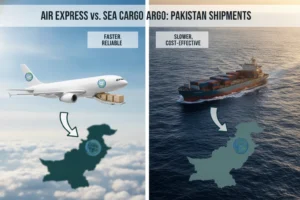
Booking express cargo to Pakistan from the UK cuts your delivery window from nearly two months down to an average of 4 to 7 business days. Beyond just speed, moving goods by air fundamentally changes how your shipment is handled and protected along the route.
Express Cargo Fact`s
| Factor | Express Air Cargo | Standard Sea Freight |
|---|---|---|
| Average Transit | 4–7 business days | 6–8 weeks |
| Customs Channel | Dedicated express clearance lanes | Bulk manifest processing |
| Environmental Risk | Climate-controlled holds | High humidity & monsoon exposure |
| Visibility | Flight scans & GPS telemetry | Milestone-only port updates |
The operational differences become glaring once cargo hits the ground. Standard shipping containers frequently sit in staging yards at Port Qasim or Karachi Port for weeks, especially during peak monsoon months when localized flooding and labor bottlenecks stall operations. That prolonged exposure means ambient moisture can seep into packaging, ruining sensitive electronics, documents, or high-end fabrics.
Air freight bypasses these maritime logjams entirely. Express consignments secure priority belly-space allocation on scheduled commercial flights or direct freighters out of hubs like Heathrow and Manchester. Once the plane touches down at airports like Islamabad (ISB) or Lahore (LHE), the cargo moves into dedicated express customs lanes rather than waiting in an endless queue of shipping containers.
You also eliminate the dreaded tracking blackout. Ocean containers routinely disappear from tracking radars for weeks while crossing international waters. Express air networks log scans at every transfer:
- Direct tarmac acceptance and pallet scanning in the UK
- Flight departure and transit hub checkpoints
- Immediate customs handoff and last-mile dispatch inside Pakistan
If timing and package integrity matter more than shaving a few pounds off your baseline freight bill, air transit pays for itself before a sea container even leaves dock.
Step-by-Step Guide to Preparing and Packing Your Consignment for Air Transit
A smooth airport turnaround starts on your packing table. When sending express cargo to Pakistan from the UK, the biggest mistake shippers make is assuming they will only pay for what the bathroom scales show. Air freight moves on space just as much as mass, which means carriers charge based on whichever is higher: actual scale weight or dimensional (volumetric) weight.

To find your volumetric weight, apply the standard IATA divisor:
$$\frac{\text{Length (cm)} \times \text{Width (cm)} \times \text{Height (cm)}}{5,000} = \text{Volumetric Weight (kg)}$$
If you pack a 4 kg sweater collection into an oversized 50 × 40 × 40 cm carton, you will be billed for 16 kg. Pick a box that leaves barely an inch of clearance around your goods.
| Package Component | Standard Spec | What to Avoid |
|---|---|---|
| Outer Carton | Double-walled corrugated cardboard (BC flute) | Single-ply supermarket or shoe boxes |
| Edge Reinforcement | Rigid, heavy-duty cardboard edge protectors | Relying solely on clear tape over corners |
| Void Fill | Kraft paper, expanding foam, or high-density air pillows | Loose foam peanuts (items shift to the bottom) |
Once the box is sealed with reinforced cross-weave tape, tackle the paperwork. Clear customs clearance in Lahore, Karachi, or Islamabad hinges on specific paperwork taped to the outside of the carton in a waterproof pouch:
A line-item packing list:
State individual piece counts and materials (e.g., “3 cotton shirts,” not just “used clothes”).
The declaration value:
Use a clean commercial invoice for business freight, or a non-commercial declaration for personal effects or gifts. Undervaluing goods to shave off duty almost always triggers manual inspection holds.
Dual-contact shipping labels:
Print thermal barcodes clearly—do not cover them with reflective tape. Always include an active UK mobile number alongside a local Pakistani receiver number (preferably with WhatsApp active) so local couriers can coordinate the final doorstep drop without delay.
Real-World Case Scenarios: When Express Shipping Delivers Maximum ROI
Paying premium rates for air freight only makes financial sense when speed directly protects your margins or resolves a crisis. Standard sea freight works fine for non-perishable bulk goods, but specific high-stakes situations demand the speed and chain-of-custody tracking that express cargo to Pakistan from the UK provides.

Here is how experienced shippers apply express services to protect capital and meet critical deadlines:
- Urgent textile prototyping: A Manchester apparel brand needs raw denim swatches approved before starting a massive production run. Sending fabric cuts via express courier to a mill in Faisalabad takes 3 to 4 days, preventing factory downtime that could cost thousands of pounds per idle shift.
- Essential personal and legal paperwork: Moving original land title deeds, university transcripts, or temperature-stable prescription drugs to relatives in Rawalpindi requires end-to-end security. Standard post risks customs black holes; express networks guarantee direct delivery with proof of handover.
- Fragile commercial electronics: When moving diagnostic motherboards or specialised telemetry gear to tech hubs in Islamabad, you cannot risk rough sea handling. Dedicated air waybills ensure items travel in temperature-controlled holds with compulsory signature verification on delivery.
- The pre-Eid retail crunch: UK-based Pakistani e-commerce merchants face brutal stockouts in the final weeks before Ramadan. Flying fast-turnover accessories or beauty products directly to Lahore keeps storefronts stocked right as shopping activity peaks.
Knowing When to Upgrade Your Freight
The table below breaks down the tipping points between standard air freight and express routing based on real operational risks:
| Shipment Trigger | Express Air Route | Standard Air/Sea Cargo | Operational Trade-Off |
|---|---|---|---|
| Contractual Deadline | 3–5 working days | 10–35 days | Higher freight bill, zero factory delay penalties |
| High Value / Sensitive | Door-to-door tracking | Port-to-port consolidation | Individual customs clearance vs. shared container risks |
| Seasonal Demand Shift | Rapid restocking | Pre-season bulk loading | Capital tied up in air charges vs. lost sales revenue |
A good rule of thumb: if a customs delay in Karachi will cost you more than the freight invoice itself, book express. If not, stick to consolidated cargo.
Pakistani Customs Regulations: FBR Rules, Tariffs, and Prohibited Items
Getting your goods across the tarmac at Heathrow is the easy part. The real test begins when your shipment touches down at Karachi, Lahore, or Islamabad, where the Federal Board of Revenue (FBR) enforces the Pakistan Customs Act of 1969.
Customs officers classify air freight strictly under two buckets: personal effects or commercial freight. Genuine gifts and used personal baggage carry nominal duty exemptions, but the FBR actively flags bulk items (like five identical jackets) as commercial cargo. The moment that happens, standard tariffs and withholding taxes kick in.
To clear customs without your parcel getting locked in an airport warehouse, your paperwork has to match the consignee’s legal identity:
Personal parcels:
The consignee must provide a valid 13-digit CNIC (Computerised National Identity Card).
Commercial shipments:
Importers must register with the FBR’s WeBOC (Web Based One Customs) system and provide an active NTN (National Tax Number) alongside their business sales tax registration.
A frequent misstep when booking express cargo to Pakistan from the UK involves packing contraband. Pakistan enforces zero tolerance on physical currency, bullion, pork derivatives, alcohol, and flammables. Telecommunications equipment is another major friction point. Sending an unapproved smartphone, radio transmitter, or commercial drone triggers an immediate hold until you secure clearance from the Pakistan Telecommunication Authority (PTA).
To keep rapid transit truly rapid, pay close attention to your incoterms:
| Billing Term | Who Pays Duties & Taxes? | Clearance Impact |
|---|---|---|
| DDU (Delivery Duty Unpaid) | Consignee settles fees at local customs | Slower. Packages sit until recipient visits an office or pays an agent |
| DDP (Delivery Duty Paid) | Shipper covers all charges upfront in the UK | Fast. Goods clear via pre-assessment and move straight out for final-mile delivery |
Choosing a DDP route adds a small fee on the UK side, but it bypasses the bureaucratic runaround that turns a three-day express flight into a two-week border dispute.
Common Mistakes That Delay Express Deliveries to Pakistan and How to Avoid Them
When you pay for express transit, you expect your parcel to bypass the standard transit bottlenecks. Yet, most hold-ups with express cargo to Pakistan from the UK don’t happen in the air—they happen on the tarmac at Karachi or Lahore because of easily avoidable paperwork and packing errors.
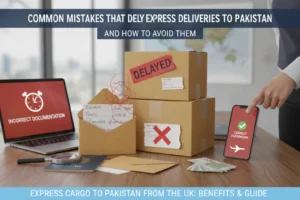
Customs clearance teams in Pakistan inspect high-velocity shipments under strict Federal Board of Revenue (FBR) parameters. A single misstep on your airway bill (AWB) or commercial invoice will freeze your parcel in a customs bonded warehouse for weeks.
Common Mistake:
| Common Mistake | Immediate Consequence | The Fix |
|---|---|---|
| Writing “Personal Effects” | Automatic manual inspection flag | Itemise every piece (e.g., “5 cotton shirts, 2 pairs used shoes”) |
| Omitting local landmarks | Courier cannot route to final mile | Provide a full address, Union Council/sector, and active Pakistani SIM number |
| Concealing power banks/laptops | Cargo offloaded before UK flight | Declare lithium-ion items upfront with a verified Material Safety Data Sheet (MSDS) |
| Undervaluing commercial items | FBR penalties, duty reassessment, or seizure | Submit authentic purchase invoices matching fair market trade values |
The most frequent tripwire is vague item descriptions. Customs officials will not accept general terms like “household goods,” “gifts,” or “mixed clothes.” If an inspector sees an ambiguous manifest, they set the box aside for physical secondary screening. You then face clearance backlogs and depot storage charges.
Address formatting is another hidden trap. Many streets in secondary cities like Gujranwala or Mirpur lack conventional UK-style house numbering. If you leave off nearby landmarks—such as a well-known mosque, chowk, or hospital—and provide an unanswered UK mobile number instead of an active local Pakistani contact, the courier simply cannot complete the final mile.
Finally, treat valuations transparently. FBR valuation systems cross-reference global commodity prices. If you declare a brand-new designer jacket or replacement engine sensors at £10 to save your recipient duty, appraisers will hit the shipment with punitive administrative fines. Clear paperwork costs nothing upfront, but it is the only real guarantee that express freight actually moves at express speed.
How to Select a Reliable UK-to-Pakistan Express Freight Forwarder
Handing your commercial pallets or urgent personal shipments to a carrier feels risky until you know who handles the handover in Karachi, Lahore, or Islamabad. If you need reliable express cargo to Pakistan from the UK, do not base your decision on the lowest headline rate per kilogram. Budget brokers often leave cargo stranded at port customs because they lack local clearance infrastructure.

Start by vetting their trade credentials. A reputable forwarder should hold direct membership with the British International Freight Association (BIFA) or FIATA. These affiliations mean the company operates under recognized standard trading conditions, adheres to strict professional liability criteria, and uses audited security procedures for air cargo screening.
Next, dig into the paperwork for insurance. Many shippers assume their goods are protected, only to discover their carrier relies on standard international conventions that pay pennies on the pound based purely on gross weight.
Coverage Type:
| Coverage Type | What It Covers | Payout Basis |
|---|---|---|
| Limited Carrier Liability | Negligence during transit only | Nominal sum per kilo (often under £2/kg) |
| All-Risk Cargo Insurance | Physical loss/damage from external causes | Full commercial invoice value |
Always ask for an All-Risk policy endorsement, especially for electronics, industrial spares, or high-value textiles.
Communication makes or breaks express freight. Test the forwarder before booking: do you reach an operations specialist in the UK, or are you routed to an unhelpful ticketing queue? You want a team with direct, daily contact with their own clearing agents at Pakistan customs hubs. A delay at Allama Iqbal International or Jinnah International requires someone on the ground who can resolve documentation queries immediately.
Finally, insist on an itemized quote. Low upfront rates often mask hidden fees that appear right before delivery. Your quote must transparently detail:
- Doorstep collection and handling fees
- Floating air fuel surcharges (FSC)
- Security screening (X-ray) costs at the UK hub
- Terminal handling and documentation release charges in Pakistan
If a forwarder refuses to put destination handling fees in writing before the cargo leaves Heathrow or Manchester, walk away.
FAQs For Express Cargo to Pakistan from the UK Works & its Benifits
How fast does express cargo actually move door-to-door?
For genuine express air freight, expect 4 to 7 business days from your UK doorstep to major Pakistani hubs like Lahore, Karachi, or Islamabad. If you are sending parcels to rural towns in Azad Kashmir or Khyber Pakhtunkhwa, tack on another 48 hours for the domestic leg.
Why pick express over traditional sea cargo?
Speed is obvious, but security and handling risk are the real differentiators. Sea freight sits inside damp shipping containers for six to eight weeks, shuffled through congested sea terminals. Express air freight bypasses that wear and tear.
| Shipping Factor | Express Air Cargo | Traditional Sea Freight |
|---|---|---|
| Transit Time | 4–7 business days | 6–9 weeks |
| Best For | High-value, urgent, fragile items | Heavy machinery, bulky household moves |
| Handling Risk | Low (palletised, direct flights) | Moderate to High (multiple transfers) |
What items will trigger delays with Pakistan Customs?
Pakistan Customs (FBR) takes a strict stance on undeclared commercial volumes posing as personal gifts. Don’t push your luck with these red flags:
- Used smartphones or laptops: These require individual PTA (Pakistan Telecommunication Authority) approvals and duty payments. Sending three identical iPhones will halt your parcel immediately.
- Perfumes and aerosols: Flammable liquids fall under IATA hazardous goods rules and won’t fly on standard express flights.
- Loose currency or bullion: Strictly prohibited; carriers will confiscate these outright.
When should you avoid express cargo?
Don’t use express cargo to Pakistan from the UK for heavy, non-urgent freight. If you’re clearing out an entire house or sending 150 kg of used clothing, express air rates will hurt your wallet. Reserve air express for time-sensitive documents, wedding wear, high-value electronics, or urgent spare parts where a two-month sea transit just isn’t an option. For the furthur information visit our service Page or contact us Now on Whatsapp.